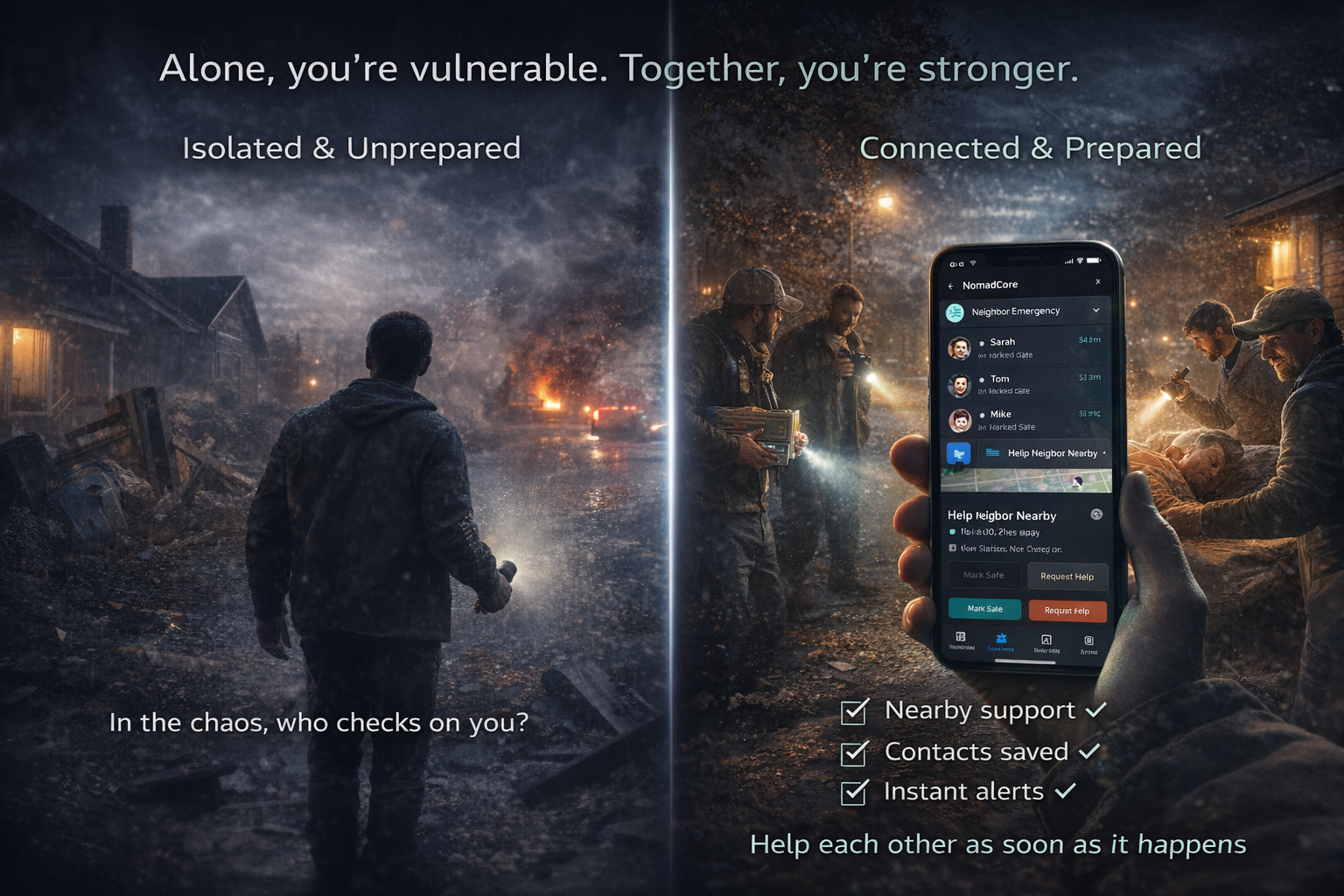
During the February 2021 Texas winter storm, emergency services were overwhelmed within hours. Power went out for 4.5 million homes. Pipes burst across the state. Roads became impassable sheets of ice. Temperatures dropped into the single digits in cities that don't own snow plows. But in neighborhoods across Texas, people survived because of their neighbors — sharing generators, pooling food and water, checking on elderly residents, and running space heaters in shared living rooms. One family's portable propane heater became the only heat source for an entire cul-de-sac.
This isn't unique to Texas. FEMA data consistently shows that in the first 72 hours of any disaster, community members rescue more people than professional first responders. After Hurricane Harvey in 2017, civilian boat owners rescued over 10,000 people while official channels were still coordinating staging areas. After the 2011 Joplin tornado, neighbors pulled survivors from rubble while ambulances were still trying to reach the damage zone.
Your neighbors aren't just the people next door. They're your first line of defense.
The 72-Hour Gap
Professional emergency response is extraordinary once it arrives. But it takes time to mobilize. National Guard deployments require governor authorization. FEMA advance teams need 24-48 hours to assess and stage. Local fire departments and EMS may be overwhelmed, damaged, or cut off from your area. In the first 72 hours of a major disaster, you are largely on your own.
The data is consistent across decades of disasters. After the 1994 Northridge earthquake in Los Angeles, an estimated 90% of people pulled from collapsed buildings were rescued by neighbors and bystanders — not by professional search-and-rescue teams. Those teams arrived later and handled the most complex extractions, but the first wave of life-saving came from ordinary people who knew where to look because they knew who lived next door.
After Hurricane Katrina in 2005, the Cajun Navy — a loose network of civilian volunteers with fishing boats — rescued over 10,000 people from flooded homes in New Orleans and surrounding parishes. They launched before the Coast Guard could reach many neighborhoods. During the 2017 Hurricane Harvey flooding in Houston, the pattern repeated: civilians in bass boats and kayaks formed spontaneous rescue fleets, navigating flooded streets while official resources were staged miles away.
The lesson isn't that professional responders are inadequate. It's that the scale of a major disaster always exceeds the immediate capacity of any emergency management system. Your community IS your emergency response during the gap that matters most.
What a Neighborhood Emergency Network Looks Like
A neighborhood emergency network is not a militia. It's not a bunker club. It's not a prepper group buying freeze-dried food in bulk. It's something much simpler and more practical: a group of nearby households that know each other's names, have each other's phone numbers, and have a loose plan for helping each other when things go wrong.
At its core, it's knowing:
- Who on your street is a nurse, EMT, or has medical training — they become your triage lead when 911 holds you for 45 minutes
- Who has a generator — and whether it runs on gas or propane, and how many outlets it has
- Who has a chainsaw — for fallen trees blocking roads after a storm
- Who has medical equipment needs — oxygen concentrators, dialysis machines, or refrigerated medications that require power
- Who has young children or can't evacuate alone — elderly residents, people with mobility limitations, single parents
- Who has ham radio equipment — when cell towers go down, amateur radio may be the only communication link
- Who has a truck, trailer, or extra vehicle capacity — for evacuation or supply runs
During the 2020 Oregon wildfires, neighborhoods that had this basic knowledge evacuated faster and more completely. Residents with trucks made extra trips to help neighbors who didn't have vehicles. People who knew their elderly neighbors needed oxygen brought them to evacuation centers first. The neighborhoods that lost people were disproportionately the ones where residents didn't know who lived three houses down.
NomadCore tip: Use NomadCore's family sharing feature to coordinate with your immediate household first, then share your emergency plans with trusted neighbors. Having your household organized before you help others makes you a more effective neighbor, not a less generous one.
How to Start One (It's Easier Than You Think)
The biggest barrier to neighborhood preparedness isn't skill, money, or time. It's the awkwardness of knocking on a door and saying "hey, want to talk about disasters?" Here's how to get past that.
Start with 3-5 neighbors you already know. You don't need the whole block. A small core group creates momentum. Text your nearest neighbors: "I've been thinking about emergency preparedness. Would you be interested in a casual get-together to talk about it?"
Host a casual "preparedness BBQ" or block meetup. Make it social first. Serve food. Let people bring their kids. The conversation will happen naturally when someone mentions the last power outage or the tornado warning that sent everyone to their basements. After the 2023 Maui wildfire that killed 101 people in Lahaina, communities across Hawaii organized exactly these kinds of gatherings — and attendance was high because the threat felt real.
Share basic contact info. Phone numbers, email addresses, and an out-of-state emergency contact for each household. Print it on a single sheet of paper everyone can keep on their fridge. This alone — just having the list — puts you ahead of 90% of neighborhoods.
Discuss skills and resources each household has. Keep it informal. "Does anyone have a generator? Does anyone know first aid? Who has a truck?" You'll be surprised what your neighbors bring to the table.
Agree on a check-in protocol. After a disaster, how will you know your neighbors are okay? The simplest system: knock on doors and place a green card in the window to signal "we're okay" or a red card for "we need help." This is the same system used by CERT (Community Emergency Response Teams) nationwide.
Join or start a CERT team. CERT is a FEMA-supported program run through local fire departments. The training is free, takes about 20 hours spread over several weekends, and covers basic disaster response: light search and rescue, fire suppression, medical triage, and team organization. Over 2,600 CERT programs exist across the United States. Contact your local fire department or visit ready.gov/cert to find one near you.
NomadCore tip: The Community Resources feature in NomadCore lets you store your network's contact info and skill inventory in one place. Add your neighbors' names, phone numbers, skills, and available resources. When the power goes out and you're working from memory, having it all in one offline-accessible list makes the difference between organized response and chaos.
The Skill-Sharing Advantage
No single family can have every skill or every tool. But a network of even 10 households might collectively include:
- Medical training — a nurse, a paramedic, someone who took a wilderness first aid course
- Mechanical and electrical skills — someone who can safely connect a generator or shut off a gas line
- Childcare capacity — families who can watch additional children while other parents handle emergency tasks
- Language skills — in diverse neighborhoods, someone who can communicate with non-English-speaking residents
- Specialized tools — chainsaws, come-alongs, bolt cutters, portable water filtration, welding equipment
- Knowledge of the area — longtime residents know where the street floods, which transformer blows first, and which road washes out
- Amateur radio capability — a licensed ham radio operator can connect with emergency management when all other communication fails
After the 2019 Nashville tornado, neighborhoods with informal skill-sharing networks cleared debris from roads within hours. One retired electrician safely reconnected a block's worth of homes to a shared generator circuit. A neighbor who was a veterinarian treated injured pets when animal control was unreachable. These weren't planned roles — they emerged naturally because people knew what their neighbors could do.
Communication When Phones Don't Work
Cell towers have backup batteries that last 4-8 hours. After that, if grid power is down, your phone becomes a flashlight with a calculator. The 2021 Texas storm knocked out cellular service for days in some areas. The 2018 Camp Fire in Paradise, California destroyed cell towers as part of the fire itself.
A neighborhood emergency network needs communication options that don't depend on the grid:
- Pre-agreed meeting times and locations — "If we lose power and can't reach each other, we meet at the park pavilion at 9 AM and 5 PM daily"
- Physical check-in boards — a whiteboard or corkboard at a central location (a neighbor's covered porch, a community mailbox area) where people post status updates
- FRS/GMRS walkie-talkies — Family Radio Service radios require no license and work within 1-2 miles in residential areas. A set of 4 costs under $40. Agree on a channel in advance.
- Ham radio — requires an FCC license (the Technician exam is 35 multiple-choice questions, and most people pass with a weekend of study) but is invaluable. Ham operators were the primary communication link during Katrina, Harvey, and the Joplin tornado.
- The green card / red card window system — used by CERT teams nationwide. Green visible in a front window means "this household is okay." Red means "we need assistance." No technology required.
NomadCore tip: Build your emergency plans in NomadCore to include neighborhood rally points, check-in procedures, and agreed-upon radio channels. When your phone has no signal, the plan is still right there on your device — NomadCore works entirely offline, even when your neighborhood loses power and cell service simultaneously.
What Communities Get Wrong
Good intentions derail neighborhood preparedness efforts all the time. Here's what to avoid:
- Over-planning. A 50-page neighborhood disaster plan that nobody reads is worse than useless — it creates a false sense of preparation. Keep your plan to one page. Contact list, skills inventory, meeting locations, communication channels. That's it.
- Excluding renters or newcomers. Renters are your neighbors. New residents are your neighbors. Students, seasonal workers, people in apartments — they all live on your street. Disasters don't check lease agreements. Include everyone.
- Assuming someone else will organize it. This is the bystander effect applied to preparedness. If you're reading this article, you're the person. Don't wait for the HOA or the block captain or the city. Send the text. Host the BBQ.
- Not practicing. Run a drill once a year. Pick a Saturday morning, pretend the power is out and phones don't work, and see if your check-in system actually functions. The 2011 Great East Japan Earthquake killed fewer people in communities that had practiced tsunami evacuations regularly — and more people in communities that had plans on paper but never rehearsed.
- Making it political or ideological. Emergency preparedness is not partisan. Tornadoes don't ask how you voted. Keep the focus on practical skills, shared resources, and mutual aid. The moment preparedness becomes about identity instead of survival, you lose half your neighbors.
Start This Weekend
You don't need a perfect plan. You need a phone number and a conversation. Text three neighbors today. Ask if they'd be interested in grabbing coffee or a beer and talking about what the neighborhood would do if the power went out for a week. That single conversation puts you ahead of almost every household in America.
After every major disaster — every hurricane, every earthquake, every ice storm, every wildfire — the stories that emerge aren't about one family with a perfect bunker. They're about neighbors who shared what they had, checked on the people who needed checking on, and worked together when the systems they relied on were temporarily gone.
Your family's emergency plan is essential. But your family plus your neighbors' families? That's a survival network.
NomadCore tip: Everything in NomadCore works offline — your emergency plans, contact lists, documents, and community resources are all stored locally on your device. When the grid goes down and cloud services are unreachable, your data is still right there. Build your plan, share it with your family, then share the approach with your neighbors. Preparedness is contagious.
Download NomadCore to build your family's emergency plan with offline access, encrypted document storage, family sharing, and community resource tracking — all accessible when cell towers and internet go down.