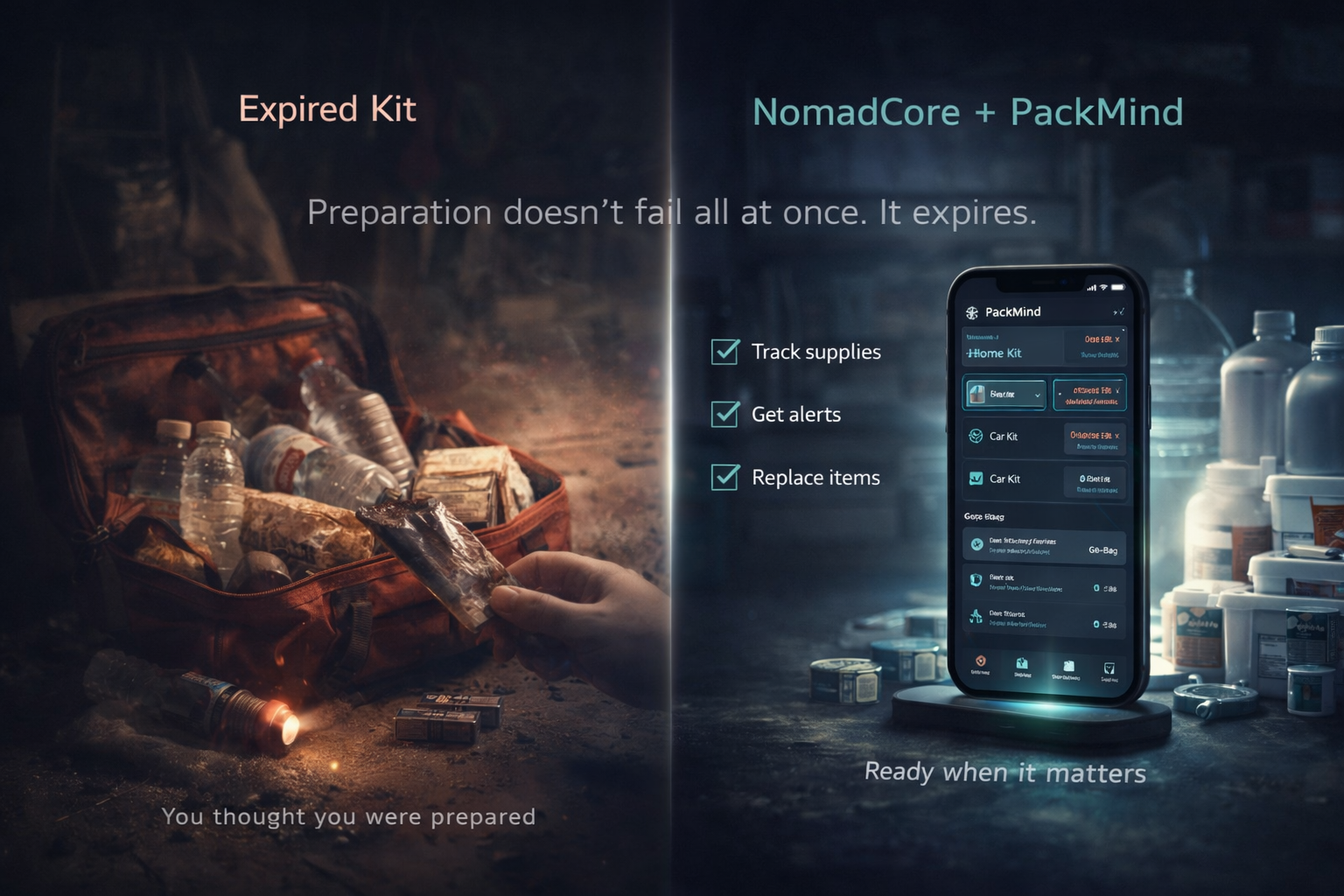
In June 2025, a family in Houston pulled their 72-hour emergency kit out of the garage closet as Hurricane season opened. The water had been bottled three years earlier — still sealed, but the plastic had warped in the Texas heat and the water tasted like chemicals. The food bars had hardened into inedible bricks. The children's Benadryl had expired 14 months ago. The batteries in the flashlight had corroded and leaked alkaline paste across the interior.
Their "emergency kit" was a box of garbage. And they didn't find out until they needed it.
This story isn't unusual. It's the norm. According to FEMA, fewer than half of American households have an emergency kit in the first place — and of those that do, most have never checked expiration dates after the initial assembly. Emergency kits are the smoke detectors of disaster preparedness: people install them and forget them. The difference is that a smoke detector beeps when its battery dies. Your emergency food bars just quietly turn rancid.
The Silent Expiration Problem
The average emergency kit contains 15 to 20 distinct items, each with its own shelf life. Some last decades. Others expire in months. And almost none of those expiration timelines align with each other, which means there's no single "check once a year" date that covers everything.
Here's what you're actually dealing with:
Water storage shelf life
- Commercially bottled water: FDA doesn't require an expiration date because properly sealed water is technically safe indefinitely. But the plastic container degrades over time, especially in heat. Taste deterioration and chemical leaching (BPA, antimony) begin within 1-2 years. Replace annually if stored above 70 degrees Fahrenheit.
- Self-stored water (tap water in containers): Must be treated with 1/8 teaspoon of unscented liquid chlorine bleach per gallon, sealed, and rotated every 6 months. Without treatment, bacteria and algae grow within weeks.
- Water purification tablets: Iodine-based tablets last about 4-5 years unopened. Chlorine dioxide tablets (like Potable Aqua) last up to 4 years. Once the bottle is opened, effectiveness drops to about 1 year due to moisture exposure.
Emergency food expiration dates
- Freeze-dried food (Mountain House, Augason Farms): 25-30 years sealed in #10 cans. But once opened, shelf life drops to 1-2 years depending on humidity. Pouches have shorter base shelf life — typically 7-10 years.
- MREs (Meals Ready to Eat): 5 years at 75 degrees Fahrenheit. But shelf life is extremely temperature-sensitive. At 85 degrees, MREs last about 3 years. At 100 degrees — common in a Texas, Arizona, or Florida garage — shelf life drops to roughly 1 year. The U.S. Army's Natick Soldier Research Center published Time-Temperature Indicator data showing MRE quality degrades on a logarithmic curve with heat.
- Canned goods: High-acid foods (tomatoes, fruit, pickles) last 12-18 months. Low-acid foods (meat, vegetables, soups) last 2-5 years. Dented or bulging cans should be discarded immediately regardless of date.
- Energy bars and granola bars: 6-12 months typically. Fats go rancid. Chocolate coatings bloom. The caloric density you're counting on degrades.
NomadCore tip: PackMind lets you add every item in your kit with its expiration date and flags items as they approach expiration. Open the app and instantly see what's expiring within 30 days — no spreadsheet required.
Medications
- Most over-the-counter medications (ibuprofen, acetaminophen, antihistamines): An FDA study conducted for the Department of Defense tested over 100 medications and found that 90% were still effective 15 years past their expiration date. For most pills and capsules in stable storage, expiration dates are conservative.
- The exceptions matter: Insulin loses potency after expiration, which can be life-threatening for diabetics. EpiPens (epinephrine auto-injectors) lose concentration over time — a 2017 study in the Annals of Internal Medicine found that EpiPens retained only about 84% of their labeled dose 50 months past expiration. Liquid antibiotics degrade faster than pills. Nitroglycerin tablets are unstable after opening. Tetracycline can become toxic when degraded.
- Prescription medications: Rotate these every time you get a refill. Put the newer prescription in your medicine cabinet and move the older supply to the emergency kit.
Batteries and electronics
- Alkaline batteries (AA, AAA, D): 5-10 years shelf life, but heat accelerates self-discharge and corrosion. A battery stored at 85 degrees loses charge roughly twice as fast as one stored at 70 degrees. Leaked alkaline (potassium hydroxide) is corrosive and will destroy whatever device it's inside.
- Lithium batteries: 10-20 years shelf life and far more heat-resistant. Worth the higher cost for emergency kits.
- Portable battery packs: Lithium-ion cells self-discharge at about 2-3% per month. A fully charged power bank left in a kit for a year may be at 70-75% capacity. Recharge every 3-6 months.
First aid supplies
- Adhesive bandages: The adhesive degrades over 3-5 years. Old Band-Aids won't stick to skin.
- Antibiotic ointment (Neosporin): Expires in 1-2 years. Effectiveness drops after that.
- Chemical cold packs: The ammonium nitrate inner pouch can lose its charge over time. Most are rated for 3-5 years.
- Elastic bandages: Lose elasticity after 2-3 years, especially in heat. A stretched-out ACE wrap provides no compression.
- Hydrogen peroxide: Breaks down into water within 1-3 years of opening (6 months in a warm environment). Unopened, it lasts about 3 years.
The Rotation System That Actually Works
Knowing shelf lives is step one. Building a system that keeps you ahead of expiration is what actually prevents the "box of garbage" scenario. Here are three approaches, ranked by effectiveness:
The FIFO method (First In, First Out)
This is the same inventory system every grocery store, warehouse, and military supply depot uses. When you buy new supplies, they go to the back. You consume from the front. It's simple, but it requires a physical layout that supports it — a shelf or bin where items are organized by date, not just thrown in a bag.
- Label every item with purchase date AND expiration date using a Sharpie on the outside of the packaging
- When adding new supplies, place them behind existing items of the same type
- Move items approaching expiration into your regular household use — eat the emergency food bars for lunch, use the older batteries in a TV remote
- Replace consumed items immediately, not "when you get around to it"
The birthday check method
Check your emergency kit on every family member's birthday. For a family of four, that's four inspections per year — roughly quarterly — without needing to remember arbitrary dates. Each check takes about 20 minutes:
- Open the kit and visually inspect every item
- Check expiration dates against today's date
- Test flashlights, radios, and other electronics
- Verify water containers aren't swollen, discolored, or leaking
- Check medications for discoloration, unusual smell, or texture changes
- Replace anything that expires before the next birthday on the calendar
The seasonal rotation
Check your kit at every daylight saving time change — the same reminder used for smoke detector batteries. This gives you two inspections per year. It works, but twice a year can miss fast-expiring items like self-stored water (6-month rotation) if the timing is off.
NomadCore tip: Categories in PackMind let you organize supplies by kit — home kit, car kit, office kit, go-bag. When you open the app, you see at a glance what's expiring this month across all your kits, without digging through every bag and bin.
What Happens When You Use Expired Supplies
Expiration dates aren't arbitrary. Here's what actually goes wrong when you rely on supplies past their useful life:
- Expired water purification tablets: Reduced chemical concentration means incomplete pathogen elimination. In a scenario where you're purifying creek or flood water, "mostly purified" still means E. coli, Giardia, or Cryptosporidium exposure. Waterborne illness during a crisis — when hospitals may be overwhelmed — can be fatal.
- Expired medications: For most drugs, the risk is reduced potency, not toxicity. But reduced potency is its own crisis. An asthmatic whose expired inhaler delivers 60% of the expected dose during a smoke event is in serious trouble. An expired EpiPen during anaphylaxis buys less time before reaching a hospital that may be far away.
- Expired food bars: Rancid fats cause nausea, vomiting, and diarrhea. During an emergency, when clean water is scarce and medical care is limited, gastrointestinal distress is more than discomfort — it causes dehydration, which compounds every other problem.
- Corroded batteries: Leaked alkaline (potassium hydroxide) destroys the battery contacts and circuit boards of flashlights, radios, and other devices. The device is now dead, not just the battery. You can't just swap in fresh cells — the damage is permanent.
- Degraded first aid supplies: Bandages that won't adhere. Antiseptic that's become sterile water. Tourniquets with weakened elastic. In a trauma situation, unreliable supplies are worse than no supplies — they waste time while you discover they don't work.
Building a Tracking System
The fundamental problem with emergency supply expiration tracking isn't knowledge — it's follow-through. Everyone knows they should check their kit. Almost nobody does consistently. The solution is a system that does the remembering for you.
Spreadsheet approach
A simple spreadsheet with columns for item name, category, purchase date, expiration date, and kit location technically works. In practice, it fails because nobody opens a spreadsheet every month to check dates. The spreadsheet is always out of date, because you forget to update it when you add or remove items. It requires discipline that decays over time.
Calendar reminders
Setting individual calendar reminders for each item's expiration is better — the reminder comes to you instead of you going to it. But with 15-20 items expiring at different times, your calendar becomes cluttered with "check MRE shelf life" events that you start dismissing out of habit.
The PackMind approach
NomadCore's PackMind feature was built specifically for this problem. Add items to your inventory, set expiration dates, and the app handles the rest. Items approaching expiration are flagged automatically — open PackMind and you'll instantly see what needs replacing, organized by urgency. No manual tracking needed. Items are organized by kit, so your car kit, home kit, and office supplies each have their own view.
NomadCore tip: Family sharing means one person can manage supply tracking for the entire household. When Dad replaces the water in the car kit, Mom sees the updated expiration date immediately. No more "I thought you checked the kit" conversations after a storm warning.
Your Emergency Kit Maintenance Checklist
Use this as a reference every time you inspect your kit:
- Check all water containers for swelling, discoloration, or leaks
- Verify all food items are within expiration dates and show no signs of damage
- Inspect medications — replace any that are expired, discolored, or have changed texture
- Test all battery-powered devices (flashlights, radios, chargers)
- Check batteries for corrosion or swelling — replace immediately if found
- Verify first aid supplies: test adhesive on bandages, check ointment dates, inspect elastic tension
- Confirm water purification tablets or filters are within their effective date range
- Update clothing sizes for children who have grown since last check
- Recharge any lithium-ion battery packs to full capacity
- Rotate self-stored water (every 6 months) and re-treat with bleach
- Move near-expiration items into regular household use and replace with fresh stock
- Update your tracking system with any changes — new items, new dates, removed items
The Bottom Line
The best emergency kit isn't the one with the most stuff. It's the one where everything works. Twenty expired MREs don't feed your family. A corroded flashlight doesn't light the hallway when the power goes out. An expired EpiPen doesn't buy your child the minutes they need.
Emergency supply expiration tracking isn't glamorous. It isn't exciting. But it's the difference between a kit that protects your family and a box of expired products taking up space in your garage.
Spend 20 minutes today going through your supplies. Label everything. Set up a system — any system — that will remind you before items expire. And then actually follow through when the reminders arrive.
Your kit should be ready when you need it, whether that's next week or next year. The supplies don't care whether you remembered to check them. They expire on schedule either way.
NomadCore tip: The supply audit feature in PackMind shows everything expiring this month across all your kits in one view. Open it once a month, handle the alerts, and your kit stays ready year-round. Set it up once — 20 minutes — and the app handles the tracking from there.
Download NomadCore to track every supply in your emergency kit, get expiration alerts before items go bad, and share your inventory with your family — so your kit actually works when you need it.