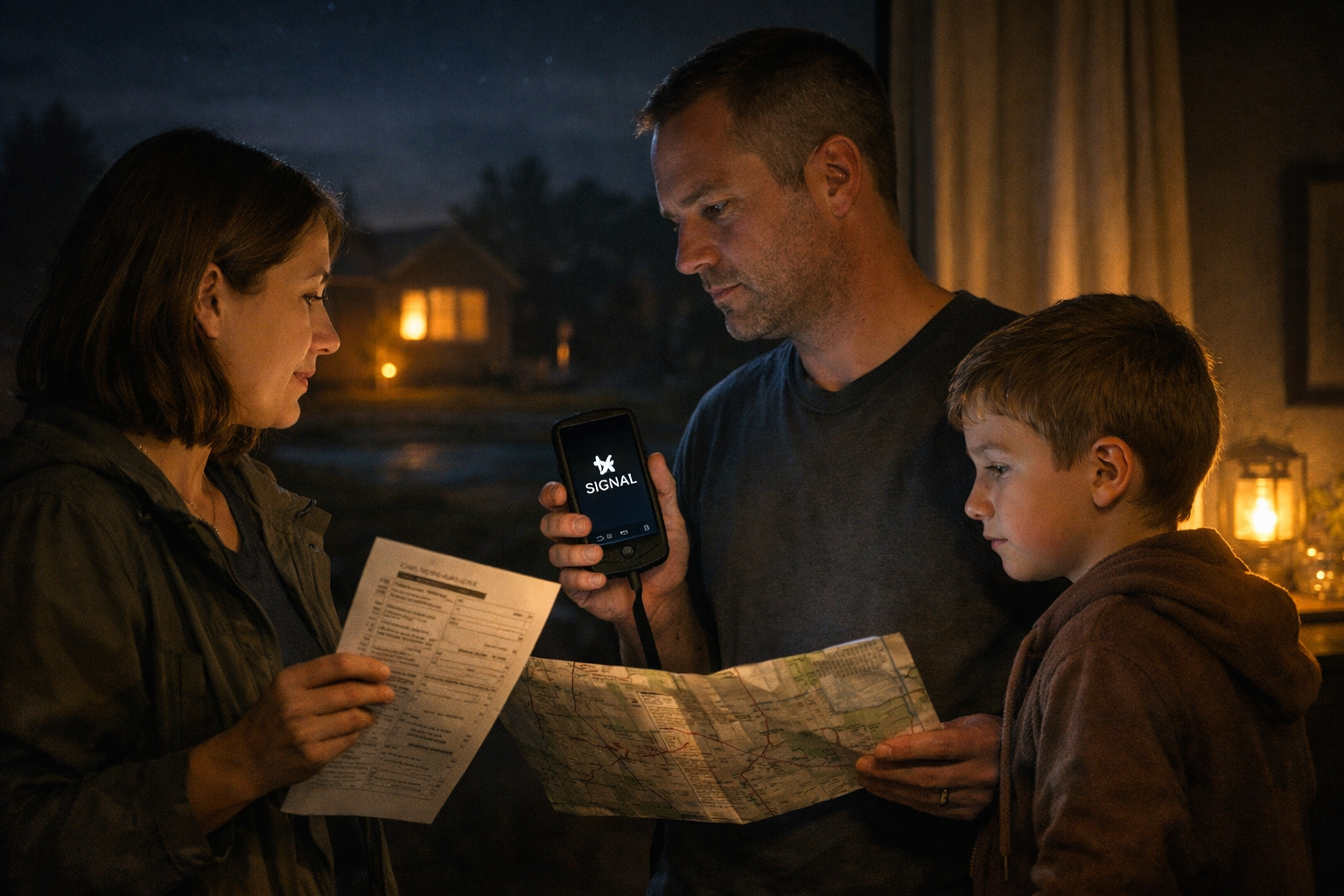
During Hurricane Harvey in 2017, cell networks in Houston were overwhelmed within hours. Millions of people couldn't call, couldn't text, and had no way to know if their family members were safe.
The families who stayed connected had one thing in common: they'd agreed on a plan before the storm hit.
A family communication plan isn't complicated. It's a simple set of agreements — who to contact, where to meet, and how to reach each other when normal channels fail. It takes about 30 minutes to set up. And it could be the most important half hour your family ever spends together.
Why Your Phone Won't Save You
Most of us assume we can always reach family by phone. Here's why that assumption is dangerous:
- Cell towers have limited backup power. Most have 4-8 hours of battery backup. After that, they go dark.
- Networks jam instantly. Everyone calls at once. During 9/11, call failure rates hit 90% in parts of New York.
- Voice calls use the most bandwidth. Texts are far more likely to go through than calls.
- Your phone battery drains faster when searching for weak signals — often dying when you need it most.
- Internet-based apps require data. If the tower is overloaded, WhatsApp and iMessage won't work either.
This doesn't mean phones are useless. It means they can't be your only plan.
The 5 Elements of a Communication Plan
A solid family communication plan covers five things. Get these right, and you're ahead of 95% of households.
1. Out-of-State Contact Person
This is the single most important element. During a local disaster, local phone lines jam — but long-distance calls often still work. An out-of-state contact acts as your family's central relay point.
How it works:
- Everyone in the family knows to call or text this one person
- Each person checks in: "I'm safe, I'm at [location]"
- The contact relays messages between family members
Choose someone who:
- Lives in a different state (ideally a different region)
- Is reliable and available during the day
- Understands their role and has everyone's numbers
In NomadCore: Add your out-of-state contact as a priority emergency contact. Every family member with the app can reach them with one tap — even without searching through their own contacts. You can also add notes like "Call Aunt Maria first" to your family emergency plan so it's always visible.
2. Meeting Points
If phones are down and you're separated, you need pre-agreed places to find each other. Set up two:
| Meeting Point | When to Use It | Example |
|---|---|---|
| Near-home | House fire, gas leak, localized event | Neighbor's mailbox, end of the block |
| Out-of-neighborhood | Evacuation, widespread disaster | Library parking lot, church, school |
Make sure everyone can get there independently. Kids should know the route on foot. Practice walking it together at least once.
In NomadCore: Set rally points on the map within your family emergency plan. Each rally point includes a name, GPS coordinates, and notes (e.g., "Meet at the flagpole entrance"). These work offline — no data connection needed to pull up the map.
3. Communication Priority Order
When an emergency hits, try these methods in order:
- Text message (SMS) — Uses minimal bandwidth, most likely to go through
- Social media check-in — Facebook Safety Check, Twitter/X post (if data works)
- Phone call — Try your out-of-state contact first, then local family
- Landline — If available, landlines often work when cell towers don't
- Leave a physical message — Note on the door, message at the meeting point
Key rule: Keep calls short. Say your name, your location, and whether you're safe. Hang up. Free up the network for others.
4. Kids' Wallet Cards
Children can't always remember phone numbers under stress. A simple card in their backpack or pocket solves this.
Each card should include:
- Parent/guardian phone numbers
- Out-of-state contact's phone number
- Home address
- Meeting point locations
- Any medical info (allergies, medications)
Laminate it. Keep one in their backpack and one in their coat pocket. For younger kids, schools may allow an emergency info card on file — ask.
5. Sharing the Plan with Everyone
A plan that only lives in one person's head isn't a plan. Every family member needs access.
Options for sharing:
- Print copies and put one in each go-bag
- Post one on the fridge
- Store a digital copy that works offline
In NomadCore: Build your full communication plan in the app, then share it with family members via QR code. Each person gets the complete plan — contacts, rally points, roles, notes — on their own device. It syncs when online and works completely offline when it matters most.
Special Situations to Plan For
Kids at School
- Know your school's emergency procedures and lockdown policies
- Know the reunification process — most schools have a specific pickup protocol
- Make sure the school has updated emergency contacts (not just from September)
- Teach kids: "If something happens, follow your teacher. Mom/Dad will come to [pickup point]"
Family Members at Work
- Know each other's work addresses and commute routes
- Agree on a threshold: "If [event], go home. If [worse event], go to meeting point B"
- Know alternate routes home — bridges close, highways flood, tunnels shut down
Elderly or Special-Needs Family Members
- Who is responsible for checking on them?
- Do they have medications that need to stay cold? (Power outage planning)
- Can they get to meeting points independently, or do they need a ride?
- Is a neighbor willing to be a backup check-in person?
Pets
- Who grabs the pet carrier and leash?
- Which shelters accept pets? (Many don't)
- Do you have a pet go-bag with food, medication, and vet records?
Low-Tech Backup Methods
When all electronics fail, you need analog options. These aren't outdated — they're resilient.
| Method | Range | Best For |
|---|---|---|
| NOAA Weather Radio | 40+ miles | Official alerts, weather updates |
| FRS/GMRS Walkie-Talkies | 1-5 miles | Family communication in a neighborhood |
| Whistle | ~1 mile (outdoors) | Signaling for help, locating people |
| Written notes | N/A | Messages at meeting points, door notes |
| Ham radio | Worldwide | Total infrastructure failure (requires license) |
Minimum recommendation: A battery or hand-crank NOAA weather radio (~$25) and a set of FRS walkie-talkies (~$30). For under $60, your family has comms when cell networks are down.
Build Your Plan in 30 Minutes
Sit down with your family — all of them — and fill this out together. Making it a group activity means everyone remembers it.
Step 1: Choose Your People (5 minutes)
- Pick an out-of-state contact and call them to confirm
- Pick a local backup contact (trusted neighbor or nearby friend)
- Make sure both contacts have every family member's phone number
Step 2: Choose Your Places (10 minutes)
- Pick a near-home meeting point everyone can walk to
- Pick an out-of-neighborhood meeting point with parking
- Walk or drive to both so everyone knows the route
Step 3: Fill Out the Info (10 minutes)
- Write down all phone numbers (don't rely on your phone's contacts)
- Note any medical info, medications, or special needs
- Include school/work addresses and contact numbers
- List your insurance company's claims number
Step 4: Share and Practice (5 minutes)
- Give everyone a copy (digital and/or printed)
- Make wallet cards for kids
- Quiz each other: "What's the meeting point? Who do we call?"
- Set a calendar reminder to review the plan every 6 months
In NomadCore: You can complete all four steps directly in the app. Create your emergency plan, add contacts and rally points, assign roles to family members, then share via QR code. Everyone gets the full plan on their phone — accessible offline, always up to date.
Common Mistakes to Avoid
1. Only Having One Way to Communicate
"We'll just call each other." What if you can't? Always have at least three methods: text, out-of-state relay, and a physical meeting point.
2. Not Telling the Kids
Kids handle emergencies better when they know the plan. Age-appropriate conversations reduce fear, not increase it. Practice makes it feel routine, not scary.
3. Forgetting to Update
You moved. Your sister changed her number. The school changed its pickup policy. Plans go stale. Review every six months — put it on the calendar.
4. Keeping It Only on Your Phone
If your phone dies, breaks, or gets lost in an evacuation, your plan goes with it. Have a paper backup. Have a copy in your car. Have a copy in your go-bag.
The 60-Second Version
If you only remember five things from this article:
- Pick an out-of-state contact. Everyone calls that person.
- Set two meeting points. One nearby, one further out.
- Text first, call second. Texts get through when calls don't.
- Give kids a wallet card with phone numbers and meeting points.
- Share the plan so it doesn't live in one person's head.
Thirty minutes of planning today could prevent hours of panic tomorrow. Your family is worth that time.
Download NomadCore to build your family communication plan, set rally points on an offline map, add priority emergency contacts, and share everything with your family via QR code — even when the grid goes down.