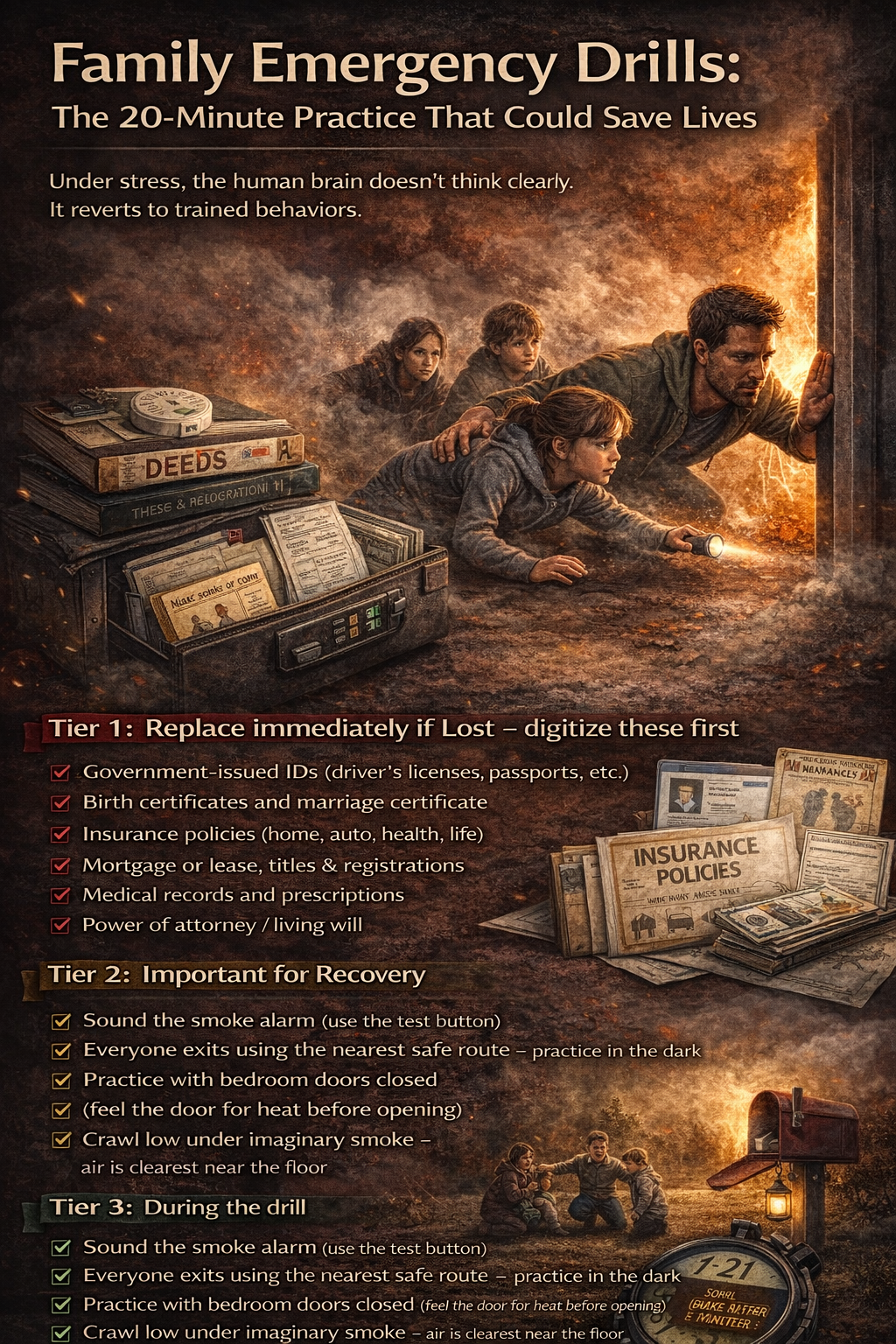
The National Fire Protection Association found that only 26% of families have developed and practiced a home fire escape plan. Of those who have a plan, less than half have actually practiced it. Here's what that means in real terms: when a smoke alarm goes off at 2 AM, three out of four families are making it up as they go, in the dark, half asleep, with children who have never been taught what to do.
A plan you haven't practiced is a plan that doesn't exist.
The good news is that changing this takes less time than a single episode of television. Twenty minutes, four times a year, can mean the difference between a family that freezes and a family that moves.
Why Drills Matter More Than Plans
Under stress, the human brain doesn't think clearly. It reverts to trained behaviors. This is why firefighters, paramedics, and pilots drill the same procedures hundreds of times -- not because they don't understand them, but because understanding isn't enough when adrenaline floods the brain and fine motor skills degrade.
The same principle applies to your family. A printed escape plan on the refrigerator is a start, but it means nothing if your eight-year-old has never actually walked the route from their bedroom to the meeting spot outside. Studies on emergency response consistently show that practiced responses are 2-3x faster than unpracticed ones. In a house fire, where you may have less than two minutes to get out, that speed difference is everything.
For children especially, repetition creates confidence instead of panic. A child who has practiced crawling low under smoke five times will do it automatically. A child who has only heard about it will stand up, breathe in hot gases, and freeze. Drills replace fear with familiarity. They turn abstract danger into a specific set of actions your child already knows how to do.
The Home Fire Drill
House fires are the most common emergency families face, and nighttime fires are the most deadly. Your fire drill should simulate the worst-case scenario: it's dark, everyone is asleep, and the smoke alarm is going off.
Before the drill
- Test all smoke alarms -- replace batteries if needed
- Identify two escape routes from every room in the house
- Pick a meeting spot outside: the mailbox, a specific tree, or a neighbor's driveway
- Make sure everyone knows to never go back inside for anything
During the drill
- Sound the smoke alarm (use the test button)
- Everyone exits using the nearest safe route -- practice in the dark
- Practice with bedroom doors closed (feel the door for heat before opening)
- Crawl low under imaginary smoke -- air is clearest near the floor
- Meet at the designated spot outside
- Account for every family member -- do a headcount
- Time it: the goal is everyone out in under 2 minutes
Special considerations
- Sleeping with doors closed: A closed door is one of the most effective fire safety measures. In a house fire, a room with an open door can reach 900 degrees Fahrenheit. A room with a closed door stays closer to 100 degrees. Teach your kids to sleep with doors shut.
- Two-story homes: Every bedroom on the second floor needs an escape ladder. Buy them, store them under the bed or in the closet, and practice deploying them. The first time your child uses an escape ladder should not be during a real fire.
- Young children: Do they know to get low? Do they know not to hide under the bed or in the closet? Children's instinct during a fire is to hide from the noise and confusion. Drills teach them to move instead.
Frequency: Practice your home fire drill at least twice a year. The NFPA recommends once at night and once during the day, since escape feels very different in the dark.
NomadCore tip: NomadCore's emergency plans include drill tracking — log each practice session with a built-in timer, checklist, participant list, and notes on what to improve. Set your next drill date to keep your family on track.
The Severe Weather Drill
Severe weather drills vary by threat. The key is matching the drill to the hazards in your region.
Tornado drill
- Everyone to the interior room on the lowest floor, away from windows
- Get under a sturdy table or mattress if possible
- Cover your head and neck with your arms
- Time it: everyone should be in position in under 60 seconds
- Practice the "alert" sound -- play the actual Emergency Alert System tone so kids recognize it instantly
Hurricane evacuation drill
- Practice the full evacuation sequence: grab go-bags, load the car, review the route
- Assign roles: who loads the car, who grabs the pet, who secures the house
- Know your evacuation zone and shelter locations
- Practice with a realistic timeline -- you may have 24 hours, or you may have 6
Winter storm shelter-in-place drill
- Locate all emergency supplies: blankets, flashlights, batteries, camp stove
- Practice setting up an emergency heat source safely
- Know where the water shut-off valve is (pipes may freeze and burst)
- Test your backup power plan: do you have a generator? Portable battery? Are they charged?
The Earthquake Drill
Earthquakes give zero warning. There is no alarm, no forecast, no 30-minute head start. The shaking starts and you react with whatever your body has been trained to do.
The correct response is Drop, Cover, Hold On:
- Drop to your hands and knees before the shaking knocks you down
- Cover your head and neck under a sturdy desk or table
- Hold On to the table leg so it doesn't shake away from you
Practice this in different rooms. What do you do if you're in the kitchen when it hits? The bathroom? In bed? Each room has different hazards and different cover options. Walk through each scenario so the response is automatic regardless of where you are in the house.
Post-earthquake protocol
- Check every family member for injuries
- Check for gas leaks (smell for gas, listen for hissing)
- Grab your go-bag
- Exit the building if you see structural damage -- cracks in walls, shifted foundation, broken chimney
- Move to an open area away from buildings, power lines, and trees
- Do not re-enter the building until it has been inspected
Important myth to correct: Doorways are NOT safer than other parts of the house. That advice dates back to unreinforced adobe buildings where the door frame was the strongest part of the structure. In modern construction, you are far better off under a sturdy table than standing in a doorway.
NomadCore tip: Kora's Guide has step-by-step procedures for each emergency type, including earthquake response. Review them with your family before drilling so everyone understands the "why" behind each step.
The Evacuation Drill
Whether it's a wildfire, a chemical spill, or a flood warning, the evacuation drill tests your family's ability to leave the house quickly with everything that matters.
The full sequence
- Alarm sounds (use a timer or verbal cue)
- Everyone grabs their assigned go-bag
- Load the car -- bags, pets, critical supplies
- Driver reviews evacuation route (primary and backup)
- Car is moving -- clock stops
Time the entire sequence from alarm to car moving. Identify bottlenecks: Who took too long? What was forgotten? Was the go-bag where it was supposed to be? Did the pet cooperate?
Practice two scenarios
- 30-minute warning: You have time to be deliberate. Grab extra supplies, secure the house, take a final walkthrough.
- 5-minute warning: Grab people, pets, go-bags, keys. Nothing else. This is the scenario that reveals whether your system actually works under pressure.
The "what if we're separated" plan
Practice the scenario where the family isn't together when the emergency happens. Kids are at school, one parent is at work, the other is at home. Who picks up the kids? Where does everyone meet? What's the out-of-area contact number everyone has memorized? This plan needs to be drilled verbally, not just written down.
NomadCore tip: Use the family sharing feature so everyone has the same emergency plan on their device. When the family is separated, each person can check the plan independently -- same meeting points, same routes, same contact numbers.
Making Drills Work With Kids
The biggest mistake parents make with emergency drills is scaring their children. A drill that creates anxiety defeats its own purpose. The goal is confidence, not fear.
- Frame it as a game, not a threat. "We're going to practice being really fast helpers today" works better than "We need to practice in case the house catches fire."
- Use age-appropriate language. For young children: "We're going to practice our special exit plan." For teens: give them the real information and a real role.
- Praise participation, don't scold mistakes. "You remembered to close your door -- great job!" matters more than "You forgot to stay low."
- Let kids lead the drill sometimes. Hand a teenager the stopwatch and let them call "go." Give a younger child the job of checking that the meeting spot is clear. Ownership builds buy-in.
- Assign real roles to teens: "You're in charge of the pet." "You grab the go-bag from the hall closet." "You help your little brother with his shoes." Real responsibility creates real readiness.
Debrief afterward: Sit down together and ask: "What did we do well? What was hard? What should we change?" Let the kids answer first. Their perspective often reveals gaps adults miss -- the window that's too stiff for small hands, the escape route that's blocked by furniture, the meeting spot that's confusing in the dark.
The Drill Debrief
Every drill should end with a short evaluation. This is what turns a one-time practice into a system that improves over time.
What to evaluate
- Did everyone know what to do without being told?
- How long did it take? Is it faster than last time?
- What was forgotten or left behind?
- Were there any physical obstacles -- locked windows, blocked paths, missing supplies?
- Did everyone make it to the meeting spot?
- Does anything in the emergency plan need to change based on what we learned?
Write down your findings. Update your plan. Then schedule the next drill. The families who are best prepared aren't the ones with the most elaborate plans -- they're the ones who practice the basics until those basics are automatic.
NomadCore tip: After each drill, update your plan in the app with lessons learned. Over time, you'll build a record of what works and what doesn't -- and your plan will get tighter with every practice session.
Download NomadCore to build your family emergency plan with drill tracking, step-by-step procedures, family sharing, and offline access -- everything you need to practice before it matters.