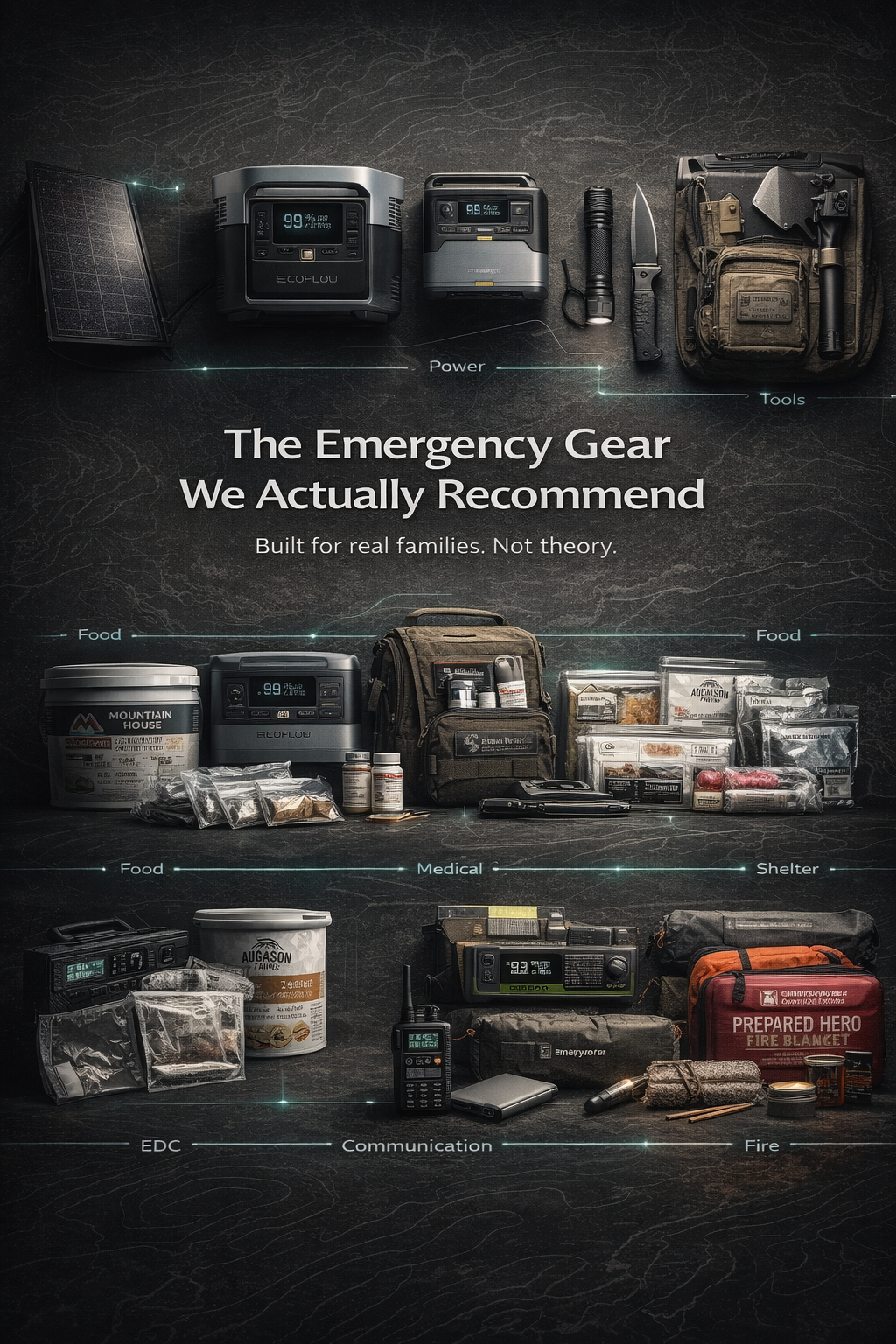
Building an emergency kit can be overwhelming. There are thousands of products, endless "top 10" lists, and a lot of gear that looks impressive but doesn't hold up when it matters. This guide cuts through the noise. Every item here is something we've researched, tested, or used ourselves. We organized them by the same categories you'll find in NomadCore's PackMind inventory system, so you can track everything in one place after you buy it.
Disclosure: Some links below are affiliate links. If you purchase through them, NomadCore earns a small commission at no extra cost to you. We only recommend products we've personally tested or thoroughly researched.
Water Filtration & Storage
Water is the single most critical resource in any emergency. You need one gallon per person per day at minimum, and FEMA recommends a three-day supply on hand at all times. But storage alone isn't enough — you also need the ability to make questionable water safe to drink. A layered approach combining storage, filtration, and chemical purification gives you options no matter what situation you face.
LifeStraw Personal Water Filter
$14-20
The LifeStraw is the gold standard for personal water filtration. It filters up to 1,000 gallons of water without chemicals, batteries, or moving parts. It removes 99.9999% of waterborne bacteria and 99.9% of parasites. At under two ounces, there's no reason not to have one in every go-bag and hiking pack your family owns.
Best for: go-bags and hiking packs.
Sawyer Products MINI Water Filter
$20-30
The Sawyer MINI punches well above its weight. It filters an astonishing 100,000 gallons — enough to last a family years — and comes with a squeeze pouch and drinking straw. It's lighter and more versatile than the LifeStraw, with the ability to attach directly to standard water bottles or use inline with a hydration pack.
Best for: lightweight filtering with huge capacity.
LifeStraw Family 1.0
$65-75
When you need to filter water for a group, the gravity-fed LifeStraw Family handles up to 18,000 liters without any power source. Hang it from a tree branch or hook, fill the top reservoir, and clean water flows out the bottom. It purifies to a higher standard than personal filters, removing viruses in addition to bacteria and parasites.
Best for: home base camp or family shelter-in-place.
Big Berkey Gravity-Fed Water Filter
$280-360
The Big Berkey is the premium home filtration option and a favorite in the preparedness community for good reason. Its 2.25-gallon stainless steel construction is built to last decades, and the Black Berkey filters handle 6,000 gallons before replacement. It requires no electricity, no plumbing, and no pressure — just gravity. Pour water in the top, drink from the spigot at the bottom.
Best for: home emergency water when utilities fail.
WaterBrick Stackable Storage (4-Pack)
$70-90
Storing water in old milk jugs is a recipe for bacterial contamination. WaterBricks are purpose-built, food-grade containers that hold 3.5 gallons each (14 gallons total in this 4-pack). They stack like building blocks, fit in closets and under beds, and can also store dry goods like rice and beans. The compact design solves the biggest complaint about water storage: space.
Best for: garage/closet water storage.
Aquatabs Purification Tablets (100 Pack)
$12-18
Aquatabs are the backup to your backup. Each tablet treats 4 liters of water in 30 minutes, and the entire pack fits in a shirt pocket. Used by humanitarian organizations worldwide, they're a proven chemical purification method when you can't filter. Toss a strip in every bag, glove box, and first aid kit your family owns.
Best for: backup purification in go-bags.
Power
When the grid goes down, everything that runs on electricity stops — including the devices you rely on for communication, navigation, and medical equipment. A portable power station bridges the gap between a brief outage and a multi-day event. The technology has improved dramatically in the last few years, with lithium iron phosphate (LFP) batteries offering thousands of charge cycles and solar charging capability.
EcoFlow RIVER 2 Max
$449
The RIVER 2 Max hits the sweet spot for most families. With 512Wh of capacity and 500W output, it keeps phones, radios, laptops, CPAP machines, and small appliances running for days. The standout feature is its charging speed — it goes from 0 to 100% in about an hour from a wall outlet, so you can top it off quickly before a storm. It also charges via solar panels for indefinite off-grid power.
Best for: keeping phones, radios, and medical devices running during outages.
EcoFlow DELTA 2
$999
If your family depends on powered medical equipment, wants to run a refrigerator during a multi-day outage, or lives in an area with frequent power loss, the DELTA 2 is the investment-grade option. With 1024Wh of expandable capacity and 1800W output, it handles nearly anything you'd plug into a wall. You can expand it further with add-on batteries for whole-house backup scenarios.
Best for: whole-house backup for extended outages.
Goal Zero Yeti 500
$599
Goal Zero built its reputation in the overlanding and off-grid community, and the Yeti 500 reflects that heritage. With 499Wh, water-resistant construction, and WiFi-enabled monitoring, it's designed for harsh outdoor conditions where other power stations would struggle. It pairs seamlessly with Goal Zero's ecosystem of solar panels for reliable off-grid charging.
Best for: rugged outdoor use and solar charging.
Tools & Lighting
In an emergency, basic tools become essential. A reliable flashlight, a sturdy knife, and a versatile multi-tool solve problems that no app or gadget can. These aren't luxury items — they're the tools that let you cut seatbelts, clear debris, build shelter, and see in the dark when the power is out.
WUBEN G5 Rechargeable Flashlight
$25-35
Disposable battery flashlights are a liability — the batteries are always dead when you need them. The WUBEN G5 solves this with USB-C rechargeable power, 500 lumens of output, and a compact size that fits in a pocket. Charge it with the same cable as your phone, throw it in a go-bag, and know it'll work when the lights go out.
Best for: EDC and go-bags.
KA-BAR USMC Fighting Knife
$90-120
The KA-BAR has been issued to U.S. Marines since World War II, and it hasn't changed much because the design didn't need improving. The 7-inch 1095 Cro-Van steel blade holds an edge through heavy use, and the leather handle provides a secure grip even when wet. This is not a kitchen knife — it's a serious survival tool for cutting, prying, and camp work.
Best for: serious survival and camp use.
KA-BAR Becker BK2 Companion
$80-100
Where the USMC KA-BAR excels at general survival tasks, the Becker BK2 is built for brute-force work. The 5.25-inch drop point blade is thick enough to baton through firewood, and the full-tang construction means the blade runs through the entire handle with no weak points. If you need one knife that can do the heavy lifting in a wilderness emergency, this is it.
Best for: batoning wood and heavy camp tasks.
Camping Shovel Axe Multi-Tool
$30-45
This high carbon steel combo tool packs a shovel and axe into a single compact package. It's the kind of thing you toss behind the seat in your truck and forget about until you need to dig a fire pit, clear a fallen branch from the road, or set up camp in an emergency. Not a replacement for dedicated tools, but an excellent all-in-one for vehicle kits.
Best for: vehicle kit and campsite prep.
Bushcraft Survival Auger Drill
$20-30
A scotch eye auger is one of those tools that seems niche until you need to bore a hole through wood without power tools. It's essential for building sturdy shelters, making furniture joints, and crafting tools in a long-term wilderness scenario. Lightweight, no batteries, no moving parts — just twist and bore.
Best for: bushcraft and long-term wilderness.
Food Storage
You don't need a year's supply of freeze-dried meals to be prepared. But having enough food to get your family through 72 hours without a grocery store — or through a week-long power outage where your refrigerator contents are spoiling — changes the math entirely. Freeze-dried food stores for decades, requires only water to prepare, and eliminates the "what do we eat?" question during a crisis.
Mountain House Essential Bucket
$89-99
Mountain House has been the go-to name in freeze-dried food for decades, supplying everyone from backpackers to the U.S. military. This bucket includes 22 servings of proven recipes with a 30-year shelf life. Just add boiling water, wait 10 minutes, and eat directly from the pouch. The taste is genuinely good — a far cry from the bland survival rations of the past.
Best for: long-term home storage.
Augason Farms 72-Hour Kit
$69-79
Designed specifically for the standard 72-hour emergency window, this kit packs 92 servings for a family of four. It includes breakfast, lunch, dinner, and drink options, all in a stackable bucket that doubles as storage. If you want a simple "put it in the closet and forget it" solution for your family's minimum food supply, this is the easiest entry point.
Best for: family emergency bucket.
Medical & First Aid
A first aid kit is only useful if it contains the right supplies and you know how to use them. The kits below range from comprehensive general-purpose to tactical trauma — because a bandage stops a scrape, but a tourniquet stops arterial bleeding. Consider pairing one of these kits with a basic first aid course from the Red Cross or a Stop the Bleed class.
Surviveware Large First Aid Kit
$37-45
With 200 pieces organized by injury type in labeled inner compartments, the Surviveware kit solves the biggest problem with most first aid kits: finding what you need under stress. The water-resistant bag is durable enough for vehicle storage, and the contents cover everything from minor cuts and burns to sprains and allergic reactions. It's the kit you grab for everyday emergencies.
Best for: home and vehicle kits.
RHINO RESCUE IFAK with CAT Tourniquet
$45-60
This is the kit that handles the injuries a standard first aid kit can't — severe bleeding, penetrating wounds, and chest trauma. The 17-piece tactical trauma kit includes a genuine CAT Gen-7 tourniquet (the same type used by the U.S. military), chest seals, compressed gauze, and an emergency blanket. If you carry one medical kit in your car, make it this one.
Best for: serious bleeding emergencies, car kits.
Jase Case Emergency Medication Kit
$289.95
The Jase Case fills a gap that most emergency kits ignore: what happens when you need prescription medications and pharmacies are closed, flooded, or overwhelmed? This physician-curated kit includes a course of five essential antibiotics and medications for common emergency conditions. A licensed doctor reviews your medical history and writes the prescription. It's shelf-stable and designed to sit in your emergency supplies until you need it. Note: Requires a prescription.
Best for: extended emergencies when pharmacies are inaccessible.
Communication
Cell towers have batteries that last 4-8 hours without grid power. After that, your smartphone becomes a flashlight. In every major disaster — from Hurricane Katrina to the 2021 Texas winter storm — communication infrastructure fails early and recovers late. A hand-crank NOAA radio and a two-way radio give you access to emergency broadcasts and local communication when nothing else works.
Emgykit R11 Emergency Crank Radio
$35-50
This is the Swiss Army knife of emergency radios. It receives NOAA weather alerts, AM/FM, and shortwave broadcasts — and it never runs out of power because it charges via solar panel, hand crank, or USB. The built-in 4000mAh battery also charges your phone in a pinch, and it includes a flashlight, SOS alarm, and compass. Every household should have one of these.
Best for: home and go-bag essentials.
BaoFeng UV-5R Two Way Radio
$25-35
The BaoFeng UV-5R is the most popular entry-level ham radio for a reason: it's cheap, it works, and it gives you access to 128 channels across dual bands. When cell towers go down, local ham radio operators are often the only communication network still functioning. Pair two of these for family communication within a few miles, or connect with local emergency nets. Note: Requires a ham radio license for transmitting.
Best for: local communication when cell towers are down.
Shelter
If you're forced to evacuate on foot or your vehicle breaks down, exposure kills faster than dehydration or hunger. Hypothermia can set in at 50 degrees Fahrenheit with wind and rain. An emergency shelter weighing ounces can mean the difference between a miserable night and a dangerous one. These pack small enough to live permanently in your go-bag or glove box.
Frocopo Emergency Survival Tent
$16-20
This 2-person mylar tent reflects up to 90% of your body heat back to you, weighs almost nothing, and comes with a survival whistle. It sets up in minutes with no poles or stakes — just tie the included cord to two anchor points. At this price, buy several and stash them in every kit, vehicle, and bag your family uses.
Best for: go-bags and vehicle emergency kits.
Go Time Gear Life Tent
$19-25
A step up from basic mylar blankets, the Life Tent is a fully enclosed 2-person shelter with paracord included for setup. The sealed seams and tube design offer better wind and rain protection than flat mylar sheets. It's still light enough for a go-bag but provides meaningfully more protection in sustained bad weather.
Best for: upgraded go-bag shelter option.
Fire Starting & Safety
Fire provides warmth, the ability to boil water, a way to cook food, light, and a psychological boost that's hard to overstate in a survival situation. But starting a fire when you're cold, wet, and stressed is far harder than it sounds. Redundancy matters here — carry at least two methods from different categories (spark-based, chemical, and match-based) so that a single point of failure doesn't leave you in the cold.
überleben Zünden Fire Starter
$34-39
This ferro rod throws a shower of 5,500-degree sparks in any weather — rain, snow, wind, high altitude. The included multi-tool striker doubles as a bottle opener and screwdriver. Unlike matches or lighters, a ferro rod has no fuel to leak, no flint to wear out in storage, and works reliably after years sitting in a bag. It's the primary fire-starting method for serious outdoors people.
Best for: reliable all-weather fire starting.
Black Beard Fire Starters (50 Pack)
$29-35
Having a spark source is only half the equation — you also need tinder that catches reliably. Black Beard fire starters are weatherproof, light with a single spark, and burn long enough to ignite kindling even in damp conditions. The 50-pack gives you enough for years of emergency use. Pair these with the ferro rod above for a fire-starting system that works in virtually any conditions.
Best for: stockpiling easy-start tinder.
Stormproof Waterproof Matches
$8-12
These matches relight after being submerged in water — a claim most waterproof matches can't actually back up. They burn for about 15 seconds each, giving you enough time to light damp tinder, and they come in a watertight case. At under $12, they're the cheapest fire redundancy you can add to a kit. Stash a set in every go-bag as a backup to your primary method.
Best for: backup fire starting in wet conditions.
Sterno 100-Hour Emergency Candles (6-Pack)
$25-35
When the power goes out for days, flashlight batteries don't last forever. These liquid paraffin candles burn for 100 hours each — that's 600 hours of light from a single 6-pack. They burn clean with no smoke or soot, making them safe for indoor use. During the 2021 Texas winter storm, families without power for a week learned the value of long-burn lighting the hard way.
Best for: extended power outage lighting.
Prepared Hero Fire Blanket
$19-25
A fire blanket smothers small fires instantly without the mess of a fire extinguisher — no cleanup, no chemicals, no expiration date to track. The 40"x40" size covers stovetop fires, clothing fires, and small grill flare-ups. Pull it from the quick-release tab, drape it over the fire, done. Keep one in the kitchen and one in each vehicle.
Best for: kitchen fire safety and vehicle kits.
How to Track Your Gear in NomadCore
Buying the gear is step one. Knowing where it is, whether it's expired, and making sure your family can find it — that's the part most people skip. Once you start building your kit, add every item to PackMind in NomadCore. Set the expiration dates for food, water purification tablets, and medications. Assign categories (Water, Food, Medical, Tools, etc.) and tag the location — home kit, car kit, or go-bag. The app tracks everything for you. When items approach their expiration date, they're flagged automatically so nothing expires silently in a closet. Share your inventory with family members so everyone knows what's in the kit and where to find it.
NomadCore tip: Add every item to PackMind as you buy it — set the expiration date and category so nothing expires silently.
NomadCore tip: Use PackMind's location feature to track which items are in your home kit, car kit, or go-bag.
NomadCore tip: Share your inventory with family members so everyone knows what supplies you have and where they are.
Download NomadCore to track your emergency gear with expiration alerts, location tagging, family sharing, and category-based inventory — all accessible offline when you need it most.