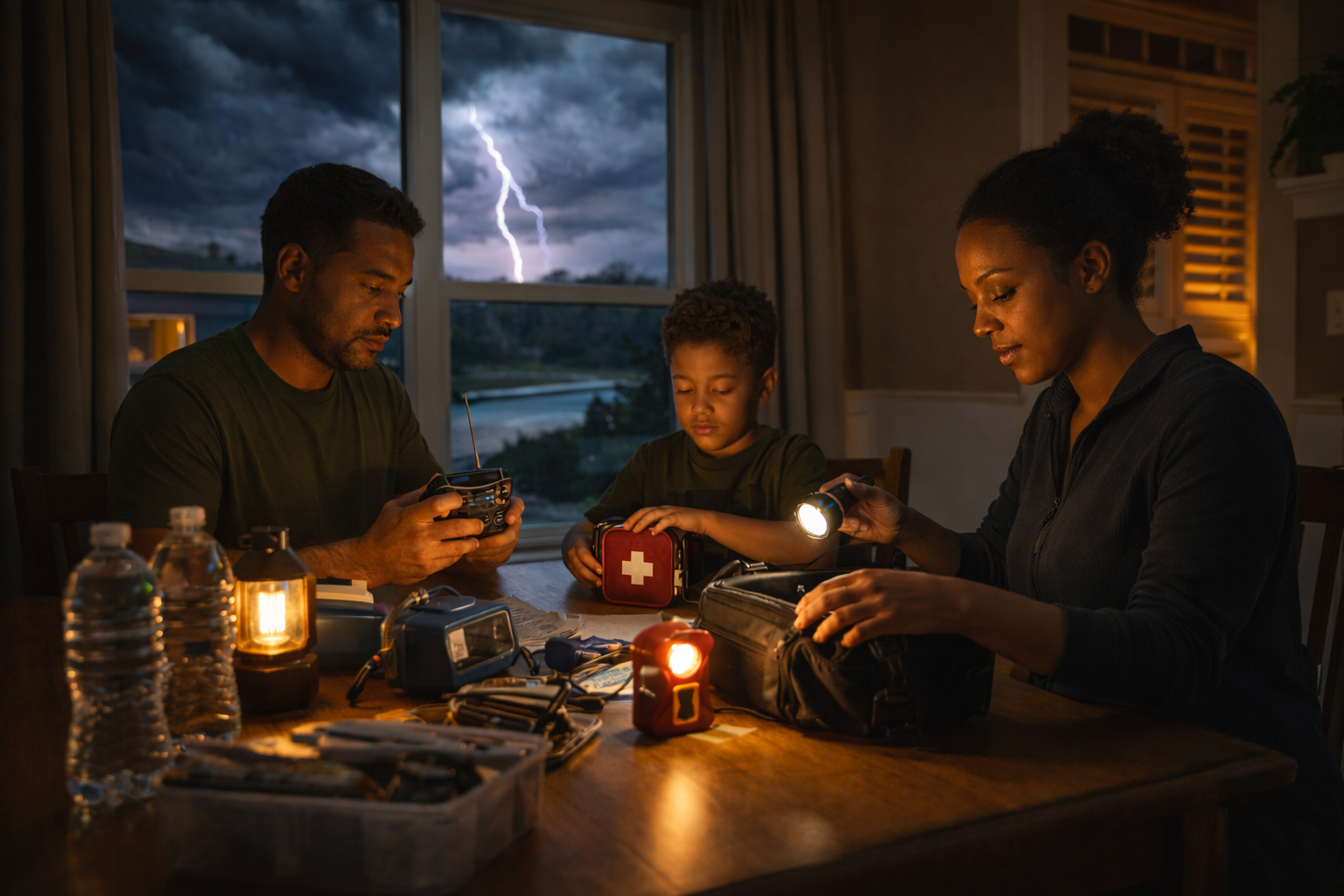
The United States averages over 1,300 tornadoes every year. When the National Weather Service issues a tornado warning, you have an average of 13 minutes before it hits. That's not a lot of time to figure out a plan from scratch.
Severe thunderstorms are even more common. They can produce straight-line winds over 100 mph, hail the size of softballs, and flash flooding that turns roads into rivers. In 2023 alone, severe storms caused over $50 billion in insured losses across the U.S.
The good news: most storm injuries and deaths are preventable with basic preparation. The families who fare best aren't the ones with the fanciest shelters. They're the ones who had a plan, practiced it, and could act without hesitation when the sirens went off.
Know Your Alerts
The most critical distinction in severe weather is the difference between a watch and a warning. Confusing the two costs lives every year.
| Alert Type | What It Means | What You Do |
|---|---|---|
| Tornado Watch | Conditions are favorable for tornadoes to develop | Stay alert. Review your plan. Keep shoes on. Charge your phone. |
| Tornado Warning | A tornado has been spotted or detected on radar | Take shelter immediately. You may have minutes. |
| Severe Thunderstorm Watch | Conditions favor severe storms (58+ mph winds, 1" hail) | Monitor conditions. Secure outdoor items. Stay near shelter. |
| Severe Thunderstorm Warning | Severe storm detected or imminent in your area | Move indoors. Stay away from windows. Be ready to shelter. |
Think of it this way: A watch means "look up." A warning means "act now."
How to Get Alerts
Don't rely on a single source. Layer your alert systems:
- NOAA Weather Radio — A dedicated receiver (~$25-40) that broadcasts 24/7 from the National Weather Service. Many models have an alarm that activates automatically for your county. This is the gold standard.
- Wireless Emergency Alerts (WEA) — The loud alerts that hit your phone automatically. Make sure they're enabled in your phone settings.
- Weather apps — Apps with push notifications provide earlier, more detailed warnings than WEA.
- Outdoor warning sirens — Designed for people who are outside. If you hear them indoors, conditions are already serious. Sirens mean "go inside and get more information," not "the tornado is overhead."
In NomadCore: The Weather Center pulls real-time severe weather data for your area and displays active watches and warnings. Set it up once with your location, and you'll have current conditions at a glance whenever you open the app.
Your Safe Room
Every household needs a designated safe room. When the warning comes, there's no time for debate — everyone should know exactly where to go.
Choosing Your Safe Room
If you have a basement: Go to the basement. Get under a sturdy table or workbench. Stay away from windows, the south and west walls (where most tornadoes approach from), and heavy appliances on the floor above you.
If you don't have a basement: Choose the most interior room on the lowest floor. Bathrooms are often ideal — the pipes in the walls add structural reinforcement, and the bathtub provides an additional layer of protection. Interior closets and hallways without windows also work.
Avoid:
- Rooms with windows or exterior walls
- Upper floors
- Mobile homes (leave for a sturdier structure or designated shelter)
- Large open rooms like gymnasiums or auditoriums — the roof span makes them vulnerable to collapse
Safe Room Checklist
Pre-stage these items in or near your safe room so you're not scrambling to gather them during a warning:
| Item | Why |
|---|---|
| Helmets (bike or sports) | Head injuries are the leading cause of tornado fatalities. A helmet dramatically reduces risk. |
| Shoes (sturdy, closed-toe) | Debris and broken glass after a storm. Never shelter barefoot. |
| NOAA weather radio | Continuous updates even if power and cell service are out. |
| Flashlight + extra batteries | Power will likely go out. Don't rely on your phone's flashlight. |
| Blankets or sleeping bags | Protection from debris and warmth if you're stuck. |
| Phone charger / battery pack | Communication and emergency calls after the storm. |
| Whistle | Signal for help if trapped under debris. |
| First aid kit | Minor injuries from flying debris or broken glass. |
In NomadCore: Add your safe room location and instructions to your family emergency plan. Note which room, which floor, and any specific instructions (e.g., "grab helmets from the hall closet"). Every family member with the app sees this information — even if they're at a friend's house and need to tell another adult where to shelter.
Storm Season Go-Bag
A go-bag for severe storms is different from an evacuation bag. This one stays near your safe room and focuses on surviving the immediate aftermath — the first 24-72 hours when power may be out and roads may be impassable.
- Water — 1 gallon per person per day, minimum 3 days
- Non-perishable food + manual can opener
- Medications — 3-day supply of all prescriptions
- Important documents in a waterproof bag (or know where your digital copies are)
- Cash in small bills (ATMs and card readers need power)
- Battery-powered or hand-crank radio
- Copies of insurance policy numbers and agent's phone number
- Change of clothes and rain gear
- Pet supplies if applicable (food, leash, carrier, medications)
Check and rotate this bag every spring before storm season begins. Replace expired food, update medications, and make sure batteries still work.
In NomadCore: Use the Document Center to store photos of your insurance cards, home inventory, and important documents. They're encrypted, stored locally on your device, and accessible offline — exactly when you need them after a storm knocks out power and internet.
During the Storm
Tornado Warning
- Move to your safe room immediately. Don't wait to see the tornado. Many tornadoes are rain-wrapped and invisible.
- Put on shoes and helmets. Grab them on the way — don't detour.
- Get low. Crouch down, cover your head and neck with your arms. Get under a sturdy table if available.
- Pull a mattress or heavy blankets over you for additional debris protection.
- Stay put until the warning expires or local authorities give the all-clear. Tornadoes can shift direction and produce multiple funnels.
Severe Thunderstorm
- Get indoors. Lightning kills about 20 people per year in the U.S. If you can hear thunder, you're within striking distance.
- Stay away from windows. Wind-driven debris and large hail can shatter glass without warning.
- Unplug sensitive electronics. Power surges from lightning strikes destroy computers, TVs, and modems.
- Avoid plumbing. Don't shower or wash dishes during a lightning storm — metal pipes conduct electricity.
- If flooding starts, move to higher ground immediately. Just six inches of fast-moving water can knock an adult off their feet.
Hail
- Get inside. Large hail can cause serious head injuries and even fatalities.
- If you can't get inside, protect your head and find the most substantial cover available.
- Move vehicles into a garage if time allows — hail causes billions in vehicle damage annually.
- Stay away from windows on the side of the house facing the storm.
If You're Driving
Getting caught in a severe storm while driving is one of the most dangerous scenarios. Here's what actually works — and what doesn't.
The Overpass Myth
Never shelter under a highway overpass. This is one of the most dangerous and persistent myths in tornado safety. Overpasses act as wind tunnels, actually accelerating wind speeds beneath them. People who climb up into the girders are exposed to the fastest winds and the most debris. Multiple fatalities have occurred under overpasses that were used as shelter.
What to Actually Do
- If you can safely drive to a sturdy building, do so. Gas stations, restaurants, and stores are better than your car.
- If you can't reach a building, pull over, park, keep your seatbelt on, and duck below the windows. Cover your head with a jacket or blanket.
- As a last resort, if a tornado is bearing down and you can't drive away, get out of the car, find the lowest ground nearby (a ditch or ravine), lie flat and face down, and cover your head. Stay away from trees and cars, which become projectiles.
- Never try to outrun a tornado unless you can clearly see it and have a clear escape route at right angles to its path. Tornadoes can change direction without warning and can be hidden by rain.
After the Storm
The storm has passed. The immediate danger is over. But the aftermath has its own hazards — and people are often injured or killed in the hours after the tornado, not during it.
Immediate Hazards
- Downed power lines. Assume every downed line is live. Stay at least 35 feet away. If a line is on your car, stay inside and wait for the utility company.
- Gas leaks. If you smell rotten eggs (mercaptan), leave the building immediately. Don't flip light switches or use your phone — sparks can ignite gas. Call 911 from outside.
- Structural damage. Don't re-enter your home if walls are leaning, the roof is sagging, or you hear creaking. Wait for a structural assessment.
- Broken glass and nails. Wear sturdy shoes. Puncture wounds from debris are one of the most common post-storm injuries.
- Contaminated water. If your area flooded, don't drink tap water until authorities confirm it's safe. Flood water carries sewage, chemicals, and bacteria.
Document Everything
Before you clean up or make repairs, document the damage for insurance claims:
- Photograph everything. Wide shots of each room, close-ups of specific damage. Photograph the exterior from all sides.
- Video walkthrough. Narrate what you see. This provides context that photos alone can't.
- Make a written list of damaged or destroyed items with estimated values.
- Save receipts for any emergency repairs (tarps, boarding up windows). Insurers typically reimburse reasonable mitigation costs.
- Contact your insurance company as soon as possible. After a major storm, claims adjusters get backed up fast.
In NomadCore: Use Family Sharing to keep your entire household on the same page during and after a storm. When family members are separated — kids at school, a parent at work — everyone can see the same emergency plan, the same safe room instructions, and the same rally points. No one is left guessing what to do, even if phones can't get through.
Teaching Kids Without Scaring Them
Children pick up on their parents' anxiety. If you're panicked about tornadoes, they will be too. The goal is to make storm preparedness feel as routine as a fire drill — something you practice, not something you fear.
Age-Appropriate Approaches
- Ages 3-5: Keep it simple. "When the loud noise goes off, we go to our special safe spot really fast. It's like a game — let's practice!" Focus on the action, not the danger.
- Ages 6-10: Explain what storms are in basic terms. Let them help stock the safe room supplies. Give them a job during drills ("You're in charge of bringing the flashlight").
- Ages 11+: Teach them the real mechanics. Show them how to read a radar app. Explain Watch vs. Warning. They're old enough to understand and will feel more confident, not more scared.
Making Drills Routine
- Practice at least twice a year — once before spring storm season and once before fall severe weather season.
- Time your drills. From wherever you are in the house, how fast can everyone get to the safe room? Make it a fun challenge, not a solemn exercise.
- Practice at night. Many tornadoes hit after dark. Can your kids find the safe room in the dark? Do they know where the flashlight is?
- Debrief afterward. "What did we do well? What could be faster?" This reinforces the plan without fear.
Children who have practiced storm drills are calmer during actual events. They know what to do. That confidence is the single best thing you can give them.
The 60-Second Version
If you only remember five things from this article:
- Watch means "look up." Warning means "act now." Know the difference and have multiple ways to receive alerts.
- Pick your safe room. Lowest floor, most interior room, away from windows. Everyone in the house should know where it is.
- Pre-stage supplies. Helmets, shoes, flashlight, radio, phone charger. Don't scramble during a warning.
- Never shelter under an overpass. It's a wind tunnel, not a shelter.
- Document before you clean up. Photos, video, written inventory. Your insurance claim depends on it.
Thirteen minutes isn't a lot. But it's enough — if you already know what to do.
Download NomadCore to build your family storm plan, set safe room locations, store insurance documents offline, and share your emergency plan with every family member — even when the power is out and the cell towers are down.