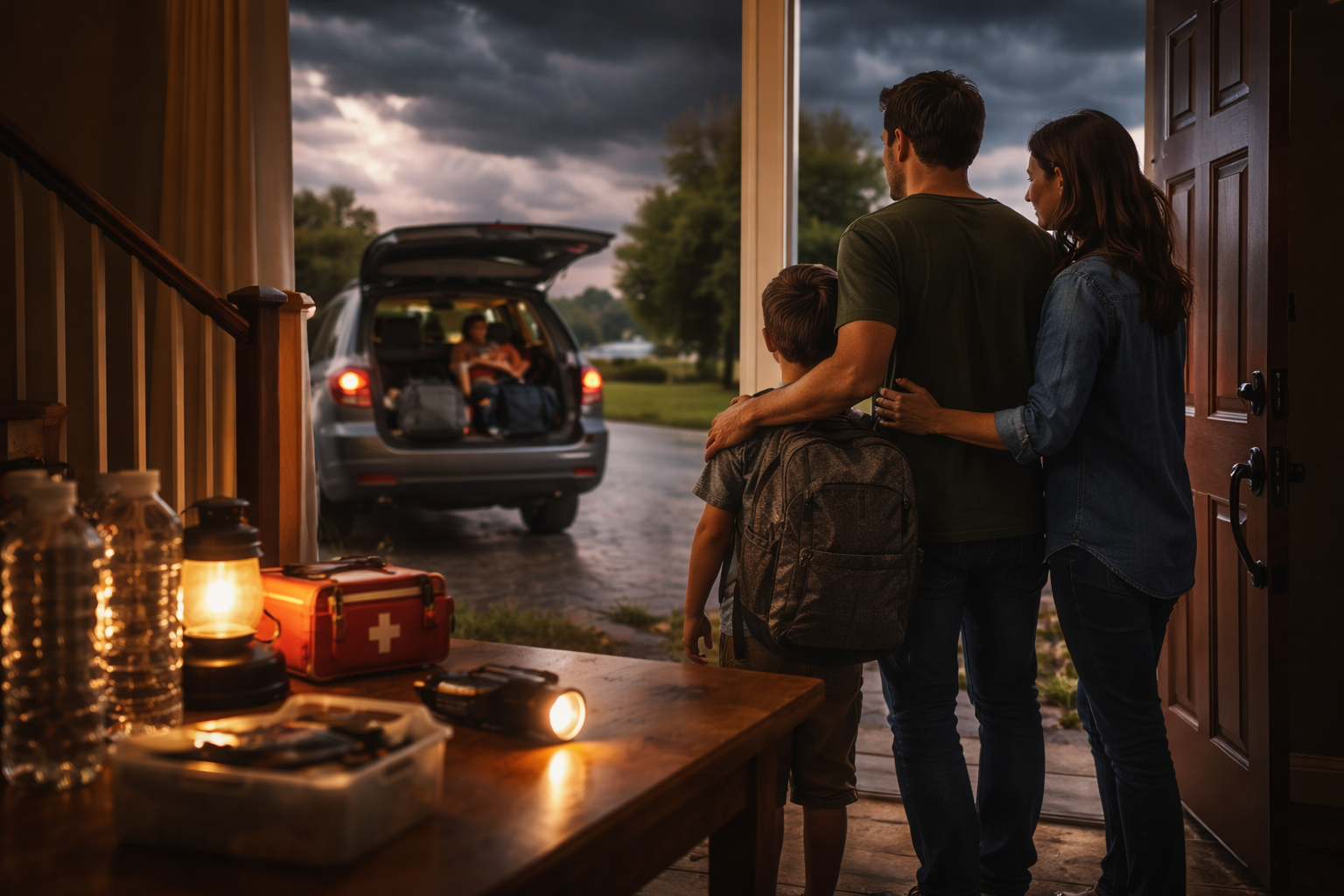
In August 2005, roughly 100,000 people stayed in New Orleans as Hurricane Katrina made landfall. Many who could have left didn't. Over 1,800 people died. Six months later, the city was still uninhabitable in places.
In February 2021, Winter Storm Uri locked Texas in ice. Millions lost power. Some families tried to evacuate on frozen highways and ended up stranded in cars with no heat, no fuel, and no shelter. They would have been safer staying home under blankets with the gas stove off and pipes dripping.
Two disasters. Two opposite mistakes. The people who died in Katrina stayed when they should have left. The people who crashed on black ice during Uri left when they should have stayed. The decision between sheltering and evacuating is one of the highest-stakes calls you will ever make.
This article gives you a framework to make that call correctly.
The Core Question
Forget courage. Forget gut instinct. The shelter-vs-evacuate decision has nothing to do with bravery or fear. It comes down to one question:
Which option reduces my family's risk more — staying put or moving?
Here is the simplest way to frame it:
- Is the threat OUTSIDE trying to get in? (Chemical cloud, fallout, active shooter nearby) — Shelter in place. Your walls are your advantage. Don't give them up.
- Is the threat INSIDE your area and growing? (Rising floodwater, approaching wildfire, structural collapse) — Evacuate. Your location is the danger. Leave it.
That mental model handles about 80% of scenarios. The remaining 20% is the gray zone — we'll cover that too.
When to Shelter-in-Place
Sheltering means making your current location the safest environment possible and staying there until the threat passes. Here are the scenarios where it is clearly the right call.
Chemical or Industrial Spill
A hazmat truck jackknifes on the highway. A plant releases chlorine gas. The air outside is the threat.
- Get everyone inside immediately
- Close all windows, doors, and fireplace dampers
- Turn off HVAC systems — they pull outside air in
- Seal one interior room with plastic sheeting and duct tape over vents, doors, and windows
- Move to an upper floor if possible — many chemical agents are heavier than air
- Monitor NOAA weather radio or local emergency alerts for the all-clear
Active Shooter Nearby
If a shooting is occurring in your area but not in your building:
- Lock and barricade all entry points
- Move to an interior room away from windows
- Turn off lights and silence phones
- Do not leave until law enforcement gives the all-clear
- If the shooter enters your building, the calculus changes — Run-Hide-Fight applies
Radiological or Nuclear Event
Fallout is an outside-in threat. Your building is shielding.
- Get to the most interior room on the lowest floor (basement is ideal)
- Put as many walls and as much mass between you and the outside as possible
- Seal the room if you can
- Plan to shelter for at least 24 hours — fallout intensity drops roughly 90% in the first day
Extreme Cold or Ice Storm
Roads are impassable. Wind chill is lethal. Your home, even without power, is warmer than a car stuck in a ditch.
- Stay inside. Consolidate your family into one room to share body heat
- Close off unused rooms to conserve warmth
- Use sleeping bags, blankets, and layered clothing
- Never use a gas stove, charcoal grill, or generator indoors — carbon monoxide kills silently
- Let faucets drip to prevent pipe bursts
Tornado Warning (Already in Safe Room)
If you are in a sturdy structure with a safe room, basement, or interior bathroom — you are already where you need to be. Do not get in a car.
- Move to the lowest floor, interior room, away from windows
- Cover yourself with a mattress or heavy blankets
- If in a mobile home, this is the one exception — get to a sturdier structure or a ditch
When to Evacuate
Evacuation means the danger is coming to you, and staying means being overtaken by it. Move early, move decisively.
Wildfire Approaching
Fire moves faster than people think — up to 14 mph in grass, faster uphill. If you can see flames or heavy smoke:
- Leave immediately. Do not wait for an official order
- Take your go-bag and drive away from the fire, not parallel to it
- Close all windows and vents in your home before leaving (slows fire entry)
- If trapped on the road, park in a clear area, close vents, lie on the floor, and cover up
Flooding or Rising Water
Water rises. It does not stop. Six inches of moving water knocks an adult off their feet. Two feet floats a car.
- If water is entering your home or area, move to higher ground
- Never drive through flooded roads — "Turn around, don't drown" saves lives every year
- If trapped by rising water in your home, go to the roof, not the attic (attics become traps)
- Flash floods give almost no warning — if it's raining hard upstream, don't wait to see water
Mandatory Evacuation Order
When authorities issue a mandatory evacuation, they are telling you: we cannot protect you if you stay.
- Leave. This is not a suggestion. First responders may not come for you
- Follow designated evacuation routes — they exist for a reason
- If you have no transportation, call the number provided in the order for assisted evacuation
Structural Damage to Your Home
After an earthquake, explosion, or severe storm — if your home is visibly damaged:
- Get out. Weakened structures can collapse with aftershocks or wind
- Do not re-enter to retrieve belongings until a structural assessment is done
- Smell gas? Leave immediately, do not flip light switches, and call 911 from outside
Gas Leak
If you smell sulfur/rotten eggs or hear hissing from a gas line:
- Do not turn on or off any electrical devices
- Open windows as you exit if it's quick to do so
- Get everyone out and move upwind at least 300 feet
- Call 911 and your gas company from a safe distance
NomadCore tip: Pre-plan both shelter-in-place and evacuation procedures in NomadCore's emergency plan builder. When the moment comes, your family opens one screen and sees exactly what to do — no Googling, no debate, no wasted minutes.
The Gray Zone: When It's Not Obvious
Some situations don't have a clear answer. The right call depends on your specific circumstances.
Hurricane Approaching
This is the most common gray-zone scenario. The answer depends on:
- Your evacuation zone. If you're in Zone A or a storm surge area, evacuate. Period.
- Storm category. Category 3+ with a direct hit? Leave. Category 1 skirting your area? You can likely shelter.
- Your structure. Concrete block home vs. mobile home changes the math entirely.
- Your supplies. Can you survive 3-5 days without power, water, or outside help?
Civil Unrest
Protests, riots, or localized violence:
- If it's not on your block, shelter. Stay away from windows and monitor the news
- If it's moving toward you or escalating, leave through a route away from the activity
- Avoid main roads and gathering points
Prolonged Power Outage
The first 24 hours are usually fine. After 48-72 hours, the calculus shifts:
- Is it dangerously hot or cold? Heatstroke and hypothermia are real killers
- Do you have medications that need refrigeration?
- Is food spoiling? Do you have water that doesn't rely on an electric pump?
- Are you medically dependent on powered equipment?
The gray-zone decision factors:
- Supplies on hand. How many days can you sustain your family without resupply?
- Vulnerable family members. Infants, elderly, medically fragile people lower your shelter-in-place threshold
- Vehicle readiness. Is your car fueled and accessible? Can you actually leave?
- Route conditions. Are the roads passable? Is everyone else already gridlocked?
NomadCore tip: Save multiple evacuation routes as offline maps in NomadCore. When one route is blocked, you pull up the next — no cell signal required. Pre-save primary, secondary, and alternate routes for every direction out of your area.
How to Shelter-in-Place Properly
Deciding to shelter is step one. Doing it correctly is step two.
Seal the Room (Chemical/Radiological Events)
- Choose an interior room with few windows — ideally one bathroom
- Pre-cut plastic sheeting to fit each window and vent opening
- Use duct tape to seal sheeting over windows, vents, and the door frame
- Turn off all HVAC and fans
- A sealed room provides roughly 2-3 hours of breathable air for a small family — that is usually enough
Interior Room (Storms/Tornadoes)
- Lowest floor, center of the building
- Away from windows, exterior walls, and large open rooms
- Under a sturdy table or mattress for debris protection
Supplies to Have Staged
- Water — one gallon per person per day, minimum 3 days
- Non-perishable food and a manual can opener
- Battery or hand-crank radio (NOAA frequencies)
- Flashlights and extra batteries
- First aid kit
- Medications — at least a 7-day supply
- Plastic sheeting and duct tape (pre-cut)
- Phone charger / power bank
- Sanitation supplies (trash bags, bucket, wipes)
Communication While Sheltering
- Text your out-of-state contact: "We are sheltering at home. All safe."
- Conserve phone battery — airplane mode with periodic check-ins
- Monitor NOAA radio for official updates and all-clear
- Do not open the sealed room until authorities confirm it is safe
How to Evacuate Properly
Evacuation is not "grab your keys and drive." Done poorly, it creates new dangers. Done right, it saves lives.
Go-Bag Grab
Your go-bag should be packed and staged near the door at all times. When it's time to leave, you grab it — you don't pack it.
- One bag per person, plus one family bag with shared supplies
- Include documents (copies of IDs, insurance, medical records) in a waterproof pouch
- Cash — ATMs won't work without power
- Phone chargers and a battery bank
- Change of clothes, sturdy shoes, rain layer
Route Selection
- Have at least three routes pre-planned going in different directions
- Avoid highways if everyone else is evacuating — secondary roads may be faster
- Know bridge and tunnel closures in advance — these are common chokepoints
- If roads are gridlocked, consider whether sheltering is now the better option
NomadCore tip: Set rally points for family reunification after evacuation. If family members are separated — kids at school, parents at work — everyone knows exactly where to regroup. Each rally point includes GPS coordinates that work without cell service.
Fuel Policy
Never let your vehicle drop below half a tank. This is a year-round habit, not something you start when a storm is forecast. Gas stations lose power. Lines stretch for hours. If your tank is half full, you can drive 150-200 miles without stopping.
Pets
- Include pets in your evacuation plan — do not leave them behind
- Keep a pet go-bag: food (3 days), water bowl, leash, carrier, medications, vet records
- Know which shelters and hotels along your route accept animals
- If you have large animals (horses, livestock), arrange trailer access in advance
Securing the Home Before Leaving
- Turn off gas at the meter if flooding is expected
- Unplug major appliances to prevent surge damage when power returns
- Lock all doors and windows
- Move valuables to the highest floor if flooding is a concern
- Leave a note on the door with your destination and date of departure for first responders
The Decision Matrix
Use this table as a quick reference. Print it. Put it on your fridge. Save it in your phone.
| Threat | Action | Key Factors |
|---|---|---|
| Chemical/industrial spill | Shelter | Seal room, turn off HVAC, upper floors |
| Tornado warning | Shelter | Interior room, lowest floor, cover up |
| Active shooter nearby | Shelter | Lock, barricade, lights off, silence phones |
| Radiological event | Shelter | Interior room, maximum mass between you and outside |
| Extreme cold / ice storm | Shelter | Consolidate rooms, layer up, no indoor combustion |
| Wildfire approaching | Evacuate | Leave early, drive away from fire, close home vents |
| Flooding / rising water | Evacuate | Move to high ground, never drive through water |
| Mandatory evacuation order | Evacuate | Follow designated routes, assisted transport available |
| Structural damage | Evacuate | Don't re-enter, watch for gas leaks and aftershocks |
| Gas leak | Evacuate | No electrical switches, move upwind 300+ feet |
| Hurricane approaching | Depends | Zone, category, structure type, supplies on hand |
| Civil unrest | Depends | Proximity, escalation, route availability |
| Prolonged power outage | Depends | Temperature, medical needs, supply depth, duration |
NomadCore tip: Build supply checklists for both shelter-in-place and evacuation scenarios in NomadCore. Track what you have, what you need, and when items expire — so you're never caught off guard by an empty go-bag or expired water stores.
The 60-Second Version
If you remember nothing else from this article, remember this:
- Threat outside trying to get in? Shelter. Your walls are protection.
- Threat inside your area and growing? Evacuate. Your location is the danger.
- Not sure? Assess supplies, vulnerable members, vehicle readiness, and route conditions.
- Pre-plan both options. The worst time to figure out your shelter room or evacuation route is during the emergency.
- Mandatory evacuation order = leave. No exceptions. No debate.
The families who survive disasters are not the ones who are bravest or strongest. They are the ones who made the right decision fast — because they thought about it before they had to.
Download NomadCore to pre-plan both shelter-in-place and evacuation procedures, save offline evacuation routes, set family rally points, and keep your supply checklists current — all accessible when the grid goes down.