In 2019, a family of five got lost hiking in Joshua Tree National Park. No cell service. Temperatures dropping. Their phone had 12% battery. If they'd had an offline survival guide, they could have found information on signaling for help, building an emergency shelter, and navigating by stars. Instead, they spent a freezing night huddled under a rock ledge until a search team found them 14 hours later.
The knowledge to survive was free and widely available — just not on their phone when they needed it.
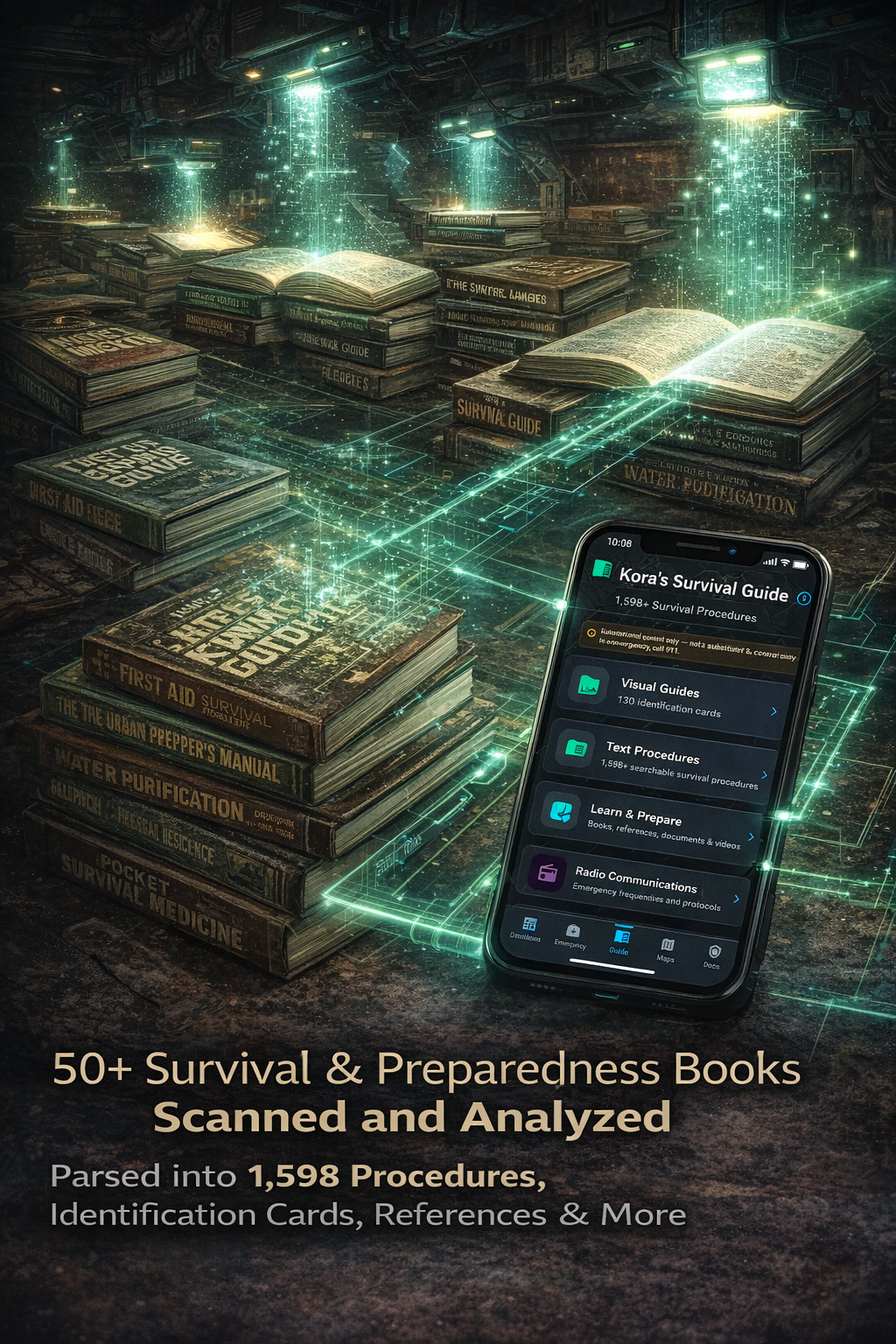
That's the gap Kora's Guide was built to fill. It's a library of over 1,400 verified survival and emergency procedures that lives entirely on your device. No internet required. No loading screens. No "you're offline" error messages. Just the information you need, the moment you need it.
What's Inside Kora's Guide
The easiest way to understand Kora's Guide is to imagine every emergency scenario your family might face — from a kitchen burn to a week lost in the backcountry — and then picture having a calm, step-by-step procedure for each one. That's what 1,400+ entries looks like in practice.
The library spans eleven major categories, each deep enough to serve as a standalone reference:
First Aid and Medical. This is where most people start, and it covers far more than bandages. CPR instructions for adults, children, and infants. Choking response for conscious and unconscious victims. Wound care from minor cuts to deep lacerations. Burn treatment by severity. Fracture stabilization and splinting. Snake bite protocols — what to do and, critically, what myths to ignore. Hypothermia recognition and rewarming procedures. Heat stroke versus heat exhaustion (they require opposite responses). Allergic reaction management, including when to use an EpiPen. There's even a procedure for delivering a baby in an emergency, because sometimes the ambulance doesn't arrive in time.
Water. You can survive about three days without water, less in heat. Kora's Guide covers every purification method — boiling, chemical treatment with iodine or chlorine, UV purification, improvised filtration, and solar disinfection. It explains how to find water sources in different terrains, proper water storage to prevent contamination, and how to test water safety when you're unsure.
Fire. Starting a fire without matches sounds like a party trick until you're wet, cold, and watching the sun go down. The guide covers friction-based methods (bow drill, hand drill), flint and steel, battery-and-steel-wool ignition, and magnifying glass techniques. Beyond starting fire, it covers fire safety in camp, cooking over open flame, and how to build signal fires that search aircraft can spot from miles away.
Shelter. A debris hut can keep you alive in freezing temperatures using nothing but forest materials. A snow cave can be warmer than a tent. The guide walks through improvised shelter construction — debris huts, snow caves, lean-tos, tarp configurations for rain, wind, and sun. It covers insulation principles, site selection (away from dead trees, above flood lines, out of wind channels), and weatherproofing techniques.
Food. Starvation isn't the immediate threat most people think it is — you can survive weeks without food. But caloric needs skyrocket in survival situations, and the guide covers edible plant identification, fishing without conventional gear, basic trapping techniques, food preservation methods, and how to estimate caloric needs based on activity and temperature.
Navigation. GPS is wonderful until the battery dies. Kora's Guide covers compass use (including declination adjustment), navigating by the sun's position, navigating by stars (Polaris isn't the only trick), topographic map reading, terrain association, and alternatives when you have no instruments at all.
Signaling, Weather, Knots, Tools, and Home Emergency. The library extends into ground-to-air signals that rescue pilots are trained to recognize, mirror signaling technique, whistle codes, cloud reading for weather prediction, 20+ essential knots with step-by-step tying instructions, improvised tool construction, and a complete section on home emergencies — gas leak response, electrical emergencies, flooding procedures, structural damage assessment, and carbon monoxide protocols.
NomadCore tip: All 1,400+ procedures work completely offline — no internet needed, ever. The entire library is stored on your device the moment you open the app. No downloading, no caching, no "save for offline" button to remember.
The Morse Code Encoder/Decoder
Of all the features in Kora's Guide, this is the one people don't expect — and the one that sticks with them longest.
Type any message into the encoder, and it converts your text into morse code: dots and dashes, ready to transmit. Receive a morse signal? Type the dots and dashes into the decoder, and it translates back to readable text.
Why does this matter in 2026? Because morse code is the most resilient communication protocol ever invented. It works with a flashlight. A whistle. A mirror catching sunlight. A stick tapping on a rock. A car horn. It requires no batteries, no satellites, no cell towers, and no internet. When everything electronic fails — and in a real emergency, it often does — morse code still works.
It's been used in rescue situations for over 150 years. Shipwreck survivors have signaled passing aircraft. Trapped miners have tapped messages through rubble. Prisoners of war have blinked messages during televised propaganda. The protocol is simple enough to learn the basics in an afternoon, and Kora's Guide makes it even simpler by doing the translation for you.
Even if you never face a survival situation, there's something satisfying about typing "HELLO" and watching it become .... . .-.. .-.. ---. Kids love it. It's a gateway into a skill that has genuine, practical value.
NomadCore tip: The morse code encoder/decoder converts text to morse and back instantly. Practice with a flashlight — three short flashes, three long, three short is SOS. It's the most universally recognized distress signal in the world, and now you can compose far more than SOS.
Where This Information Comes From
The internet is full of survival advice. Most of it is wrong, incomplete, or dangerously outdated. Kora's Guide doesn't pull from crowd-sourced wikis or unverified blog posts.
The procedures are sourced from military field manuals — including FM 21-76 (Survival) and FM 4-25.11 (First Aid), which have been refined through decades of real-world deployment. Red Cross emergency protocols provide the medical foundation. FEMA guidelines inform the home emergency and disaster response sections. Wilderness medicine references fill the gaps between military field medicine and civilian first aid.
Every procedure has been verified by subject matter experts. This isn't a collection of tips someone found interesting — it's an authoritative reference library built to the standard you'd expect from a field manual, because much of it literally comes from field manuals.
That distinction matters when you're following instructions to stabilize a fracture or purify questionable water. You need to trust that the procedure is correct. With Kora's Guide, you can.
Why Offline Matters for Survival Knowledge
Here's the uncomfortable truth about emergency preparedness: you need critical information most when you have least access to the internet.
Lost in the wilderness? No cell service. That's the definition of the problem. Major disaster — hurricane, earthquake, tornado? Cell towers go down in minutes. The 2017 Hurricane Maria knocked out 95% of Puerto Rico's cell sites. Power outage? Your home router dies with the lights.
An app that requires an internet connection to show you how to treat a burn or purify water is not a survival tool. It's a brochure that works in your living room and fails in the field.
Every procedure in Kora's Guide is stored locally on your device. Open the app on an airplane, in a cave, in the middle of the Pacific Ocean — it all works. The search function works offline. The morse code translator works offline. Every illustration, every step, every word is already on your phone.
NomadCore tip: Searchable by keyword — type "snake bite" or "water purification" and get step-by-step instructions in seconds. No scrolling through categories, no browsing. Just the answer you need, immediately.
How People Actually Use It
Hikers and campers keep it as a quick reference for wilderness skills. Even experienced outdoors people encounter unfamiliar situations — an unexpected plant rash, a water source they aren't sure about, a knot they can't quite remember. Having a verified reference beats guessing.
Parents use it for age-appropriate first aid and teaching kids outdoor skills. The choking procedure for infants is different from adults. The burn treatment for a toddler who touched the stove is time-sensitive. And when your kid asks how to tie a bowline or start a fire with a magnifying glass, you can show them step by step instead of fumbling through a YouTube search.
Preppers and preparedness-minded families treat it as a comprehensive reference library — a single source that consolidates information from dozens of manuals into one searchable, portable format. No more shelves of field manuals that are hard to search when your hands are shaking.
Travelers heading to unfamiliar environments value it for international emergencies, altitude sickness protocols, tropical disease recognition, and water purification methods specific to regions where tap water isn't safe.
Everyday families are often the most surprised by how much they use it. Home emergencies don't feel like "survival situations" until they're happening. A gas leak at 2 AM. A power outage that lasts three days. A kitchen grease fire. An allergic reaction at a birthday party. These aren't wilderness scenarios, but they demand the same thing: the right knowledge, immediately, without fumbling for a phone signal.
Beyond Survival: Everyday Value
Here's what surprises most people about Kora's Guide: the majority of its 1,400+ procedures aren't dramatic wilderness survival. They're practical knowledge for ordinary life.
How to shut off your gas main. What to do during a power outage — specifically, in what order. Basic first aid for kitchen burns (hint: cool running water for 10 minutes, not ice, not butter). How to treat a bee sting allergic reaction before the paramedics arrive. Carbon monoxide alarm protocols — when to ventilate and when to evacuate. How to assess whether a crack in your wall is cosmetic or structural.
It's the knowledge you wish you had at the exact moment you need it. The kind of information you'd search for on your phone — except in many of these scenarios, you don't have time to search, or you don't have a connection, or you're too panicked to type clearly.
Kora's Guide is designed for that moment. Open the app, type a word or two, and the procedure is in front of you. No ads. No cookie banners. No "subscribe to read more." Just the answer.
NomadCore tip: Procedures are sourced from military field manuals, Red Cross protocols, and medical references — not crowd-sourced guesswork. When the stakes are high, the source of your information matters as much as the information itself.
That family in Joshua Tree made it through the night. They were cold, scared, and dehydrated, but they survived. Not everyone in that situation does. The difference between a scary story and a tragedy is often a single piece of knowledge applied at the right time.
Kora's Guide exists so that knowledge is always within reach — whether you're lost on a trail, dealing with a home emergency, or just curious how to tie a trucker's hitch. Over 1,400 procedures, a morse code translator, and a searchable offline library that works anywhere your phone goes.
The knowledge to survive shouldn't require a Wi-Fi password.
Download NomadCore to access Kora's Guide with 1,400+ offline survival procedures, a built-in morse code encoder/decoder, and searchable first aid, navigation, and emergency references — all free, all offline.