You probably don't think of yourself as someone who needs an emergency plan. And honestly? You're probably right — most of the time.
The power comes on when you flip the switch. The water runs when you turn the tap. The grocery store three blocks away has everything you need. Your phone connects you to anyone, anywhere, in seconds. It all just works.
It works so well, in fact, that it's easy to forget it's not magic. It's infrastructure — a staggeringly complex web of systems that depends on electricity, supply chains, communication networks, and human coordination all functioning at the same time. And every year, for millions of Americans, that web quietly breaks.
Not in an apocalyptic, world-ending way. In a boring, Tuesday-afternoon, "well, this is inconvenient" way that lasts about three days.
That three-day window has a name. Emergency managers call it the 72-hour gap — the time between when something goes wrong and when organized help can actually reach you. And it's the window where most families discover, too late, that they have no plan.
The System Is Thinner Than You Think
This isn't about being pessimistic. It's about understanding how the things we depend on actually work — and how little margin they operate with.
Consider a few numbers:
That's under normal conditions. When a storm is forecast, shelves clear in hours. Bread, water, batteries, and milk vanish first. The resupply truck that normally comes every day or two can't get through because the same storm that emptied the shelves also closed the roads.
It's the same story across every system we rely on:
- The power grid runs near capacity. The U.S. grid operates with a thin reserve margin. A heat wave, ice storm, or equipment failure can tip it over the edge. In February 2021, Texas lost power for up to five days in some areas — not because the infrastructure was ancient, but because the system was designed with almost no buffer for extreme conditions.
- Cell towers have limited backup. Most run on 4 to 8 hours of battery. After that, they go dark. During any major event, the tower closest to you is also the tower closest to thousands of other people all trying to call at once.
- Water treatment needs electricity. When the power goes out, water pressure drops. In extended outages, boil-water advisories become standard because pumping stations can't maintain safe pressure.
- Emergency services get overwhelmed. After Hurricane Katrina, FEMA's own director said the agency couldn't effectively respond for the first 72 hours. That's not a failure — that's by design. Large-scale response takes time to mobilize.
None of these systems are broken. They're actually remarkable. But they're built for efficiency, not redundancy. They're optimized for the 99% of days when everything goes fine — and they struggle on the 1% of days when they don't.
FEMA's official recommendation: every household should be able to sustain itself for a minimum of 72 hours without outside help. That's not prepper advice. That's the federal government telling you the system has a known gap — and you're the one who fills it.
This Isn't About Doomsday. It's About Tuesday.
Here's the thing that gets lost in the emergency preparedness conversation: the most likely scenario isn't a hurricane or earthquake. It's something far more ordinary.
- An ice storm knocks out power for four days. You're not evacuating. You're sitting in your house, in the dark, wondering if the food in the freezer is still safe and whether the pipes are about to freeze.
- A water main breaks. Your tap runs brown for 48 hours. The city says boil everything. You have three water bottles in the fridge.
- A wildfire creates an evacuation order. You have 30 minutes to pack. What do you grab? Where do you go? Does your spouse know the plan, or are they texting you from work saying "WHAT DO WE DO?"
- A stomach bug tears through the house. Everyone's down. You can't drive to the store. Do you have enough Pedialyte, medicine, and easy food to ride it out for three days without leaving the house?
These aren't catastrophes. They're inconveniences — if you're ready. They become crises only when you're not.
The difference between the family that handles a five-day power outage with mild annoyance and the family that handles it with panic usually comes down to about $150 in supplies and one conversation over dinner.
Why We Don't Prepare (And Why That's Normal)
If you've never thought seriously about this stuff, you're in very good company. Psychologists have a name for it: normalcy bias. It's the tendency to assume that because things have always been fine, they will continue to be fine.
It's not stupidity. It's a deeply rational mental shortcut. For 364 days a year, normalcy bias is exactly right — nothing bad happens, and worrying about it would have been a waste of energy. The problem is that it also prevents you from spending the small amount of effort that would make day 365 manageable instead of miserable.
There are a few other reasons people skip preparedness, and they're all understandable:
- "I don't have time." Life is busy. Between work, kids, bills, and the actual fires you're already putting out, "organize an emergency kit" feels like it belongs on a list you'll get to in 2035.
- "It feels like a prepper thing." The loudest voices in preparedness are often the most extreme. When the conversation is dominated by bunkers and bug-out bags, normal families tune out. The vibe doesn't match their life.
- "I live in a safe area." Maybe. But power outages, water disruptions, and severe weather happen everywhere. The 2021 Texas freeze hit suburbs. The 2023 Maui fire hit a resort town. The 2024 CrowdStrike outage — a software update — grounded flights nationwide.
- "The government will help." They will. Eventually. But not in the first 72 hours — and they say so themselves. FEMA's entire public messaging is built around this: you are your own first responder.
You Already Do This in Other Areas of Life
Here's the part nobody talks about: you're already a prepper. You just don't call it that.
- You have car insurance — even though you don't plan to crash.
- You have a smoke detector — even though your house has never caught fire.
- You keep a spare tire in the trunk — even though you've never used it.
- You have jumper cables, or at least know someone who does.
- Your kid's school runs fire drills — even though the building has never burned down.
None of that feels extreme. None of it makes you a survivalist. It's just common sense — accounting for the fact that systems sometimes fail, and a small amount of advance thinking makes the failure manageable.
Emergency preparedness is the same thing, applied to your home and family. That's it. No camo, no bunker, no MREs. Just the household equivalent of a spare tire.
What Closing the Gap Actually Looks Like
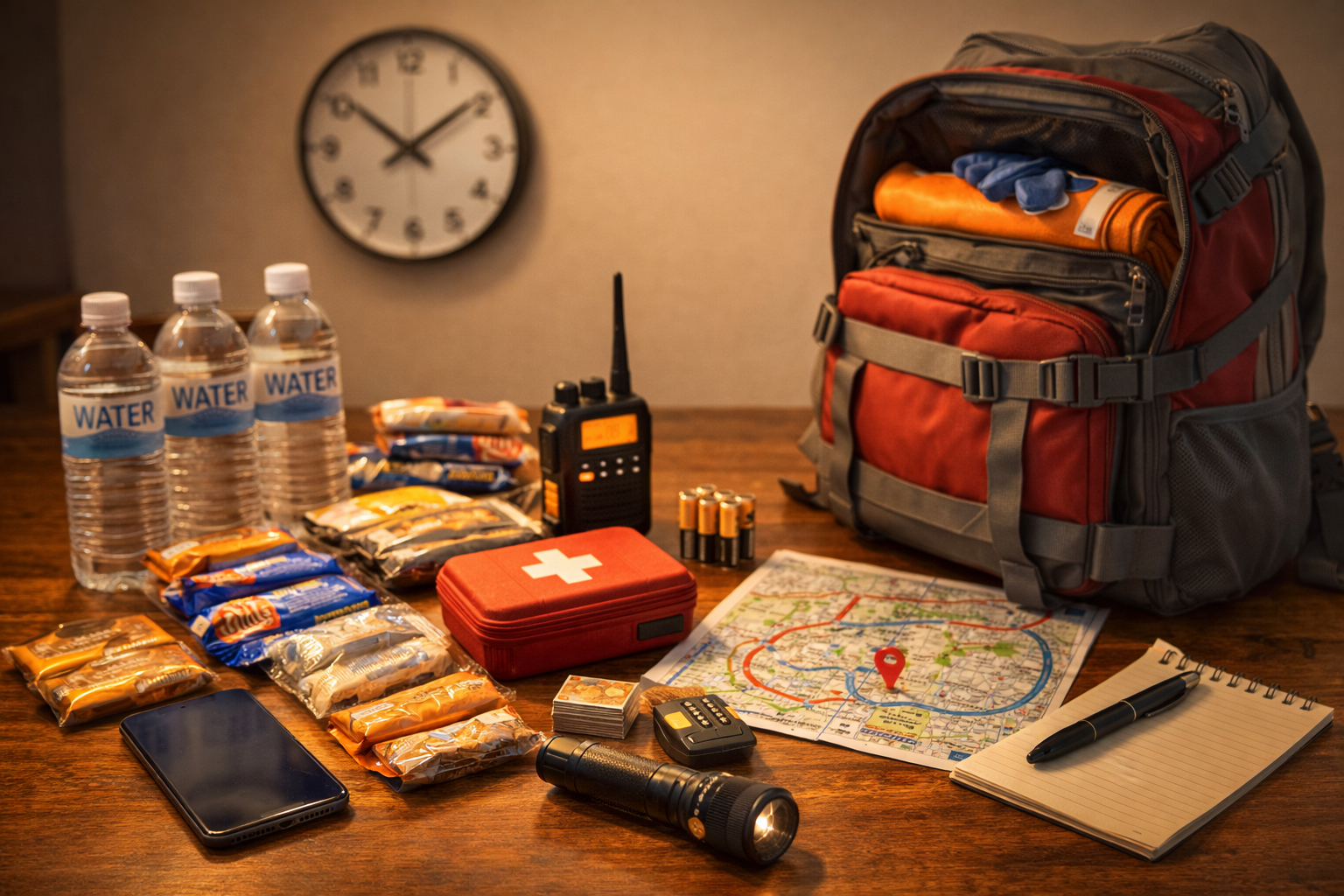
Closing the 72-hour gap doesn't require a lifestyle change. It requires about one afternoon and a modest trip to the store. Here's the honest minimum:
Water
One gallon per person per day for three days. A family of four needs 12 gallons. That's three cases of bottled water from any grocery store. Cost: about $12. Store them in a closet and forget about them.
Food
Three days of food that doesn't need refrigeration or cooking: peanut butter, crackers, canned soup, granola bars, dried fruit. You probably already have most of this in your pantry. The only shift is intentionally keeping a three-day buffer instead of buying just what you need this week.
Light and Power
A flashlight with extra batteries. A portable battery bank for your phone (you might already own one). A hand-crank or battery-powered radio that picks up NOAA weather stations — about $25 online.
Communication
A plan for how your family reaches each other when phones don't work. An out-of-state contact everyone can call. Two meeting points everyone knows. Written down, not just remembered. This costs nothing but 15 minutes of conversation.
Documents
Copies of your IDs, insurance cards, and prescriptions in a waterproof bag. If you need to leave your house in 30 minutes, proving who you are and what you own becomes suddenly important.
Total cost: Under $100 for the supplies. Under an hour for the planning. And then you never have to be the person standing in a two-hour gas line or fighting over the last case of water at the store — because you handled it on a calm Saturday when nothing was wrong.
The Mindset Shift
The most useful thing about preparedness isn't the stuff. It's the shift in how you think.
Once you've spent 30 minutes thinking through "what would we actually do if the power was out for three days?" — something changes. You stop assuming everything will always work. Not in a fearful way. In a practical way. You start noticing small things: the flashlight that needs batteries, the fact that you couldn't find your insurance card if you needed it right now, the realization that your family has literally never discussed what to do if you're separated during an emergency.
And you fix those things. One at a time. Calmly. On your own schedule.
That's not survivalism. That's self-reliance. It's the same instinct that makes you check the weather before a road trip or bring an extra layer on a hike. You're not afraid of the mountain — you just respect it enough to bring a jacket.
The systems that keep your family comfortable are remarkable — and they need a little backup. Not because they're going to fail catastrophically. Because even remarkable systems have off days. And your family deserves to be fine on those days too.
Where to Start
If this article is the first time you've thought seriously about this, here's the smallest possible first step:
- Tonight at dinner, ask one question: "If the power went out right now and stayed out for three days, what would we do?" Don't stress about the answer. Just notice what you don't know.
- This weekend, buy 12 gallons of water and put them in a closet. You've now covered the single most important resource for your family for 72 hours.
- Pick an out-of-state contact and send them a text: "Hey, would you be willing to be our family's emergency relay person? If something happens here and we can't reach each other, we'd all call you." Most people say yes immediately.
That's it. Three steps. Maybe 20 minutes total. You can do the rest later — build a kit, make a full communication plan, store important documents. But those three things alone put you ahead of the vast majority of households in America.
The 72-hour gap is real. It's not scary — it's just a fact about how infrastructure works. And closing it is one of the easiest, cheapest, most impactful things you can do for your family.
You don't have to be ready for everything. You just have to be ready for Tuesday.
Ready to take the next step? NomadCore helps you build a family emergency plan, store important contacts offline, set rally points on a map, and share everything with your family — even when the grid is down. For more on layered communication planning, check out our guides on building a family communication plan and creating a PACE plan.