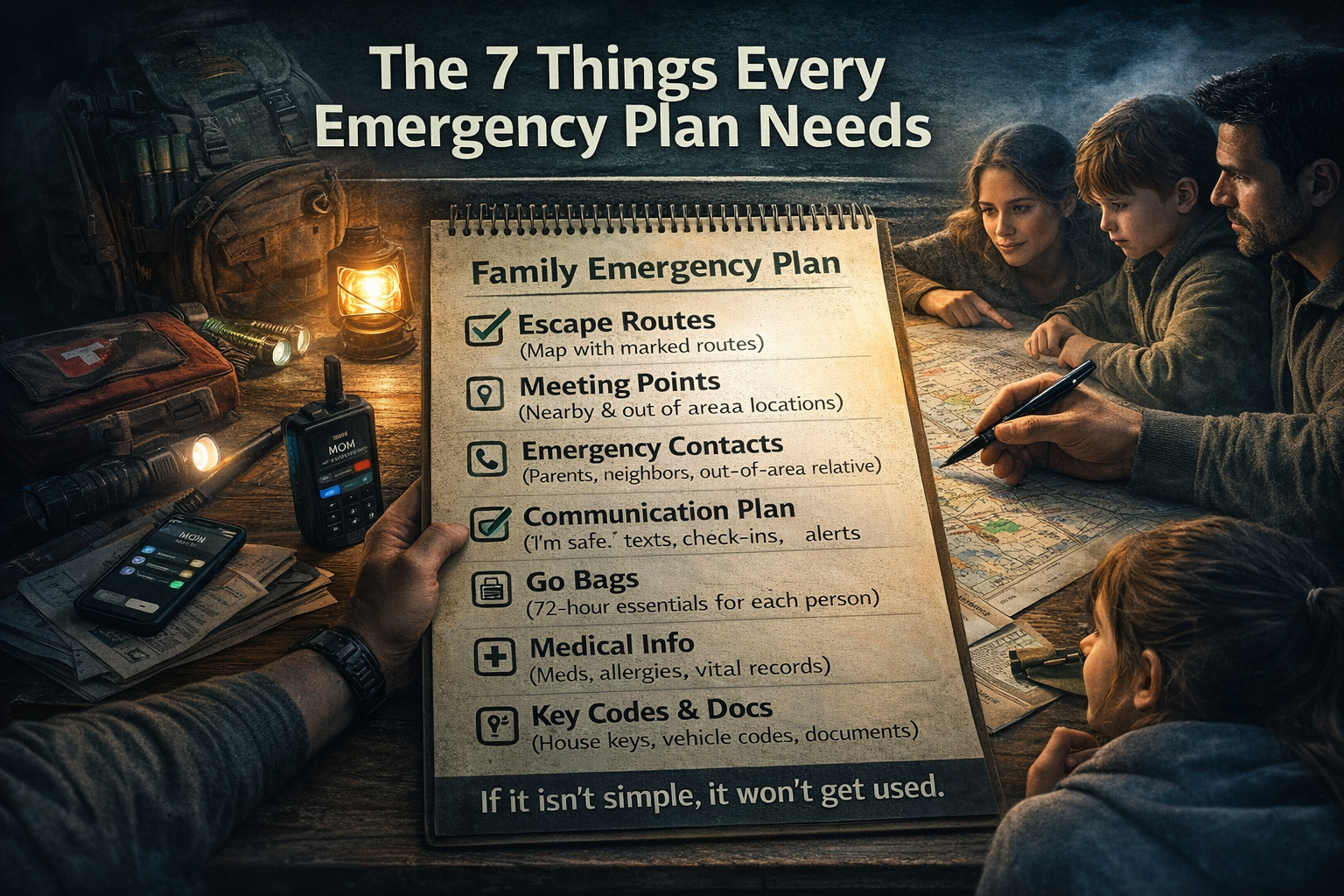
The NomadCore Field Workbook is sixteen pages of fill-in-the-blank preparedness that keep working when your phone doesn't. No battery, no signal, no account — just paper you fill out once at the kitchen table and review every few months.
This guide walks you through every form, in the order that makes sense to fill them: who your family is, where you'll meet, how you'll reach each other, what you'll grab, and what you'll live on. Set aside about an hour. You won't finish all sixteen in one sitting, and you don't need to — the first few are the ones that matter most.
Don't have it yet? Download the Field Workbook (PDF) — free, all sixteen forms, nothing to sign up for.
First, print it right
The workbook is built for a home printer, and a few settings matter:
- Margins: none. Background graphics: on. In your print dialog set margins to None (or Minimum) and switch on "Background graphics," or the module colors and the write-on rules drop out and you get a page of orphaned tick marks.
- Print at home, not at the library. Shared copiers keep print jobs on an internal disk. A filled Person Record carries medical details and a home address — that's not a page to leave in a machine you don't own.
- Single-sided, and put the emergency pages on colored paper. Color at the edge of the stack is visible under a headlamp, costs no ink, and survives a photocopy. It's how you find the right page in the dark without an index.
- Use a real pen or a pencil. The lines are sized for handwriting, not a fine-liner. Laser or pigment ink lasts longer than inkjet if the book gets damp.
Start here: where you stand
Form 00 — Readiness Index
Score yourself — 100 points — before you fill anything else in, then again after you've worked through the book. The gap between the two numbers is the whole point: it tells you the top three gaps to close first. Fill the "today" column now and leave the rest.
Form 07 — Readiness Levels
Three standing levels that never change, with triggers you write for your own hazard and county. A score tells you how prepared you are; a level tells you what to do this afternoon. Write the triggers; leave the three levels as printed.
Form 08 — Region Card
The page nobody outside your county can write for you: named hazards with their dates, named roads, named hospitals. Fill it once from what you already know, then check it whenever something local changes.
The people
Form 01 — Person Record
One sheet per household member. This is what a paramedic, a school office, or a shelter volunteer will ask for, so copy the blank page as many times as you have people. For each person, fill: legal name and what they go by, date of birth, height and weight, blood type; allergies with reaction severity; medications with dose, how often, and days of supply on hand; conditions and past surgeries; primary-care physician and insurance; any mobility, dietary, or sensory needs; workplace or school with hours and who may collect a child; an ICE contact; and the one thing this person should not leave without — an inhaler, glasses, insulin, a specific toy.
Handling: this is the most sensitive page in the book. Print and photocopy it at home, keep it where you'd keep a passport, and don't leave the filled copy in a car or a lost go-bag.
The plan: meeting and reaching each other
Form 02 — Rally Points
Four meeting layers, ordered by how far things have gone wrong — each one has to work when the one above it doesn't. Name a spot just outside your door, one outside the neighborhood, and the fallbacks beyond. The same sheet records your utility shutoffs: where the gas, water, and electrical panel are, and what tool each needs. Then test it — walk the route.
Form 06 — Communications Card
Local lines fail before long-distance ones, so route through someone far away. Write an out-of-state contact everyone calls first, a nearby local contact who isn't in your household, and a reunification plan: who collects whom, in what order, and when to stop waiting. Agree three signals in advance — "Come get me now," "I am safe, stay put," and "I am not alone / not free to talk."
Form 03 — Grab List
Built by how much time you get, not by category: four tiers at 30 seconds, 5 minutes, 30 minutes, and 2 hours. Decide now what gets left behind at thirty seconds, so nobody has to decide it later in the dark. Do a weight check once it's filled — a bag you can't carry isn't a grab list.
The supplies
Form 04 — Inventory & Rotation
Supplies you own but can't find are supplies you don't own. Log location and expiry, not just quantity. The rule is rotate, don't discard — eat and replace before things lapse.
Form 13 — Water & Sanitation Plan
Water is the first thing to run out and the last thing you can improvise; sanitation is the thing people plan for last and regret first. Set targets for drinking, cooking, hygiene, and sanitation, a survival rate and a conservation rate per day for the whole household, where waste goes on day one and on day seven, what you have for it, and a handwashing station with someone responsible for refilling it.
Form 14 — Food Plan
Eat in the order things spoil, not the order you fancy them — four phases from fridge to last resort. The one hard rule is about who absorbs a shortfall first and who never does: write the names, not the principle.
Form 10 — Power & Fuel Plan
Running on generator and battery for days is a different problem from getting through an evening, so decide your load-shedding order now, while nobody is hot and tired. Record your gasoline target and where it's stored, propane in pounds (tank sizes differ), your rotation interval and last-rotated date, and the minimum tank size the generator needs. Note the known gap — the thing you haven't solved yet — honestly.
Keep it alive
Form 05 — Drill Log
A plan that has never been rehearsed is a document, not a plan. Run one drill a quarter and write down what broke — the broken parts are the useful output. Debrief in five minutes.
Form 11 — Maintenance Schedule
Equipment that hasn't been run in a year is not equipment, it's an assumption. Work it by cadence and write the date down, because memory is the thing that fails first.
In the moment
Form 12 — First 30 Minutes
You fill this one in advance so there's nothing to fill in the moment. When the power's out and you don't yet know for how long, one person reads it aloud and the household works down the page in order, so everyone hears the same thing.
Form 09 — Reference Cards
Cut-out cards for a wallet or go-bag, carrying the agreed signals, the key numbers, and the scope line. Print, cut, and keep one on each person — print the sheet twice so you keep one copy bound.
The why — read on a Sunday
Form 15 — Long-duration Operations
Read this when nothing is wrong, not during an outage. It's the reasoning behind the other sheets, and the part that explains why the plan changes shape somewhere around day four.
Keep it current
Write the printed date on the cover, review every quarter — the Drill Log gives you the cadence — and when something changes, a new phone number, a new medication, a move, update the page then rather than waiting. When a sheet is superseded, draw a diagonal line across it and file it behind the new one.
The workbook holds no passwords and no account numbers, by design. A filled copy does hold medical details and a home address, so treat the physical book the way you'd treat those: at home, known to the family, not left in a car.
Written for the United States. General preparedness information, not medical advice, and no substitute for emergency services or an evacuation order. Sources including FEMA and Hesperian are cited in the workbook for provenance only and endorse nothing here.
Ready to start? Download the Field Workbook (PDF) and print the first few forms today. Want the same plan on every phone, offline? Get NomadCore for contacts, rally points, and your family plan in your pocket.