When an emergency hits, most people freeze. Not for a second. For 10 seconds or more. Researchers call it normalcy bias — your brain refuses to accept that something dangerous is actually happening. You stand still. You look around. You wait for someone else to react first.
The people who move fastest in a crisis aren't braver. They're not calmer. They've simply rehearsed what to do so their body acts before their brain catches up.
Here's the other thing most people don't realize: average emergency response time in the US is 7 to 10 minutes. In rural areas, it can be 15 or more. In a widespread disaster — a tornado, an earthquake, a major flood — help may not come for hours.
That means the first 15 minutes are yours. What you do in that window determines how the rest of the emergency plays out — for you and for your family.
This is the action framework. It works for any emergency. Print it. Memorize it. Practice it.
Minute 0-1: Stop, Assess, Decide
Your first job is to override the freeze. Do it with three questions:
- Am I safe right now? Look around. Is the immediate danger still present — fire, shaking, rising water, falling debris? If yes, move. If no, hold.
- Is anyone injured? A quick scan. Can everyone move? Is anyone bleeding, unconscious, or trapped?
- Do I stay or go? This is the critical decision. Some emergencies require evacuation (fire, gas leak, flood). Others require sheltering (tornado, active threat). Decide now.
This is triage, not panic. Three questions. Ten seconds. You now have a direction.
The worst thing you can do in the first minute is nothing. The second worst thing is running without knowing where you're going.
Minutes 1-3: Protect Life
Now move. Your only priority is keeping people alive.
- Get to safety. Safe room, outside the building, away from the hazard. Don't grab belongings. Don't go back for anything. Move.
- Account for family members. Headcount. Who's here? Who's missing? Where were they?
- Administer immediate first aid. Stop severe bleeding with direct pressure. Clear airways if someone is choking. Don't move anyone with a potential spinal injury unless they're in immediate danger.
- Call 911 if applicable. If there are injuries, structure collapse, fire, or active danger — call now. Be specific: your address, what happened, how many people need help.
If 911 lines are jammed, try texting 911 (available in most US counties). Keep it short: address, emergency type, number of injured.
NomadCore tip: Your emergency plan in NomadCore includes a first-15-minutes checklist pre-built into every plan template. When the shaking stops or the alarm sounds, open the app and follow the steps. No thinking required — just execute.
Minutes 3-5: Communicate
You're safe. Now let people know.
- Text, don't call. Texts use a fraction of the bandwidth that voice calls require. During network congestion, a text will get through when a call won't.
- Contact your out-of-state relay. One person outside the affected area who can relay messages between family members. Everyone texts that one person.
- Post a brief status if data works. Social media, family group chat, whatever channel your family uses. Keep it to one sentence: "Safe at home. No injuries. Standing by."
- No phone? Head to your meeting point. If you can't communicate electronically, go to the pre-agreed location. Your family should be doing the same.
Keep messages short. Name, location, status, next action. Save your battery.
NomadCore tip: Priority emergency contacts in NomadCore are accessible with one tap from the home screen. No scrolling through your address book while your hands are shaking. Tap, send, done. Your out-of-state relay, your spouse, your parents — all in one place.
Minutes 5-10: Stabilize
The immediate danger has passed or you've moved away from it. Now stabilize your situation.
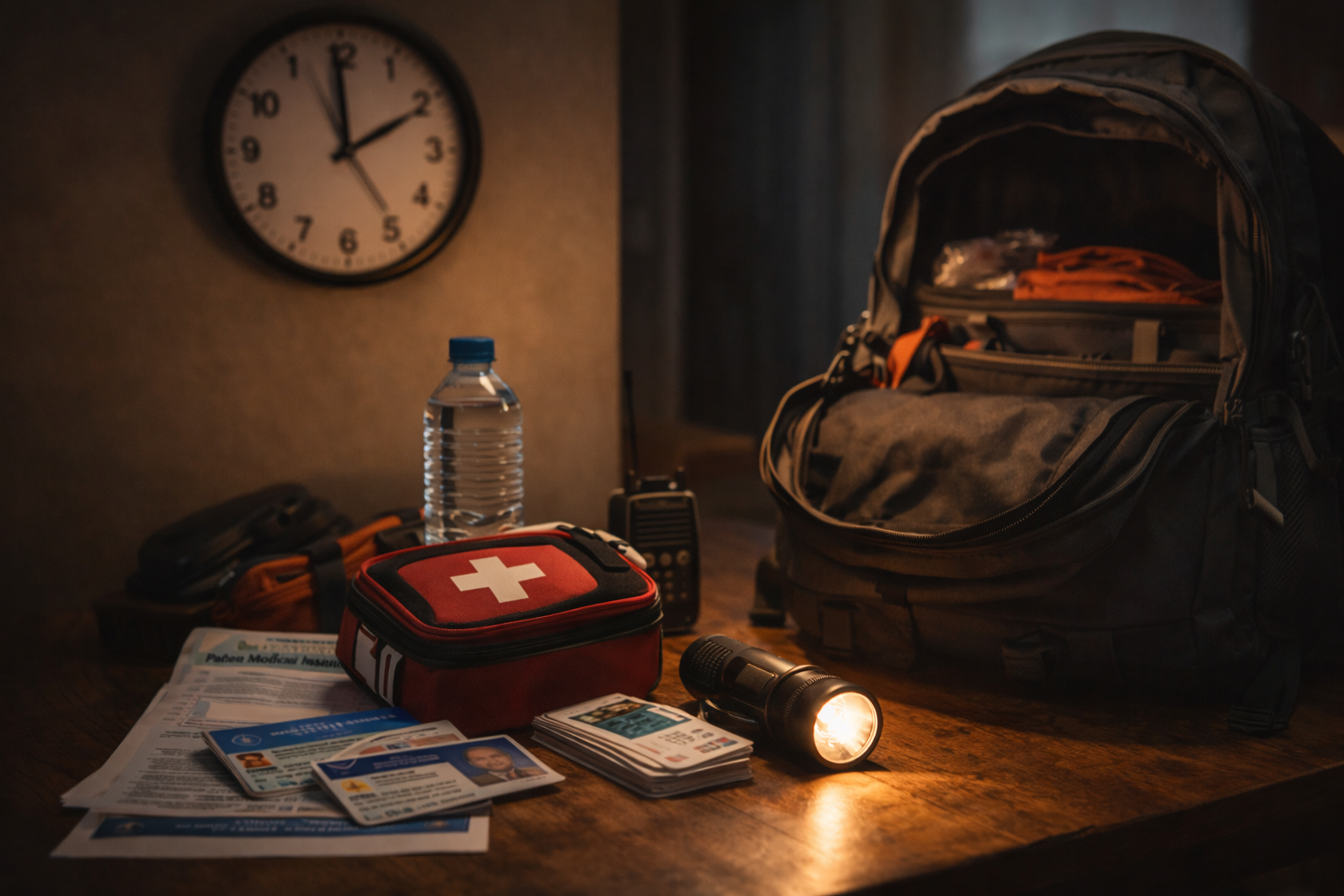
- Grab your go-bag if evacuating. This is where having one pre-packed pays off. Medications, documents, water, phone charger, cash. If you don't have a go-bag, grab: medications, wallet, phone charger, shoes. In that order.
- Turn off gas and water if there's structural damage. If you smell gas, turn off the main valve and leave immediately. Don't flip light switches — sparks ignite gas.
- Secure pets. Leash dogs. Put cats in carriers. Bring their medication if they're on any. Pets panic too — don't let them bolt out the door.
- Put on sturdy shoes. Broken glass, nails, debris — bare feet or flip-flops will injure you. Real shoes. Now.
- Take essential medication. Insulin, inhalers, heart medication, EpiPens. If you're evacuating, grab the whole supply.
NomadCore tip: NomadCore's offline maps work without cell data or Wi-Fi. When towers are down and Google Maps won't load, you still have evacuation routes, rally points, and your family's locations — all cached on your device.
Minutes 10-15: Document and Decide Next Steps
You're stable. Use these minutes wisely — they'll matter in the hours and days ahead.
- Take photos and video of damage. Insurance claims require documentation. Walk through quickly and record everything. Timestamp matters — do it now while the scene is fresh.
- Check on neighbors. Especially elderly residents, people with disabilities, and anyone who lives alone. A quick knock on the door can save a life.
- Monitor official channels. NOAA weather radio, local emergency management social media, police scanner apps. Get facts, not rumors.
- Make the big decision: shelter in place or evacuate? If authorities say evacuate, go. If your home is structurally sound and the danger has passed, staying may be safer than driving into chaos.
At the 15-minute mark, the acute phase is over. You've protected life, communicated your status, stabilized your situation, and documented the scene. Now you shift into sustained response mode — which is a different article entirely.
The Universal Emergency Checklist
Cut this out. Put it on your fridge. Put a copy in your go-bag. This works for any emergency.
Minutes 0-1: Assess
- Am I safe right now?
- Is anyone injured?
- Stay or go?
Minutes 1-3: Protect
- Move to safety
- Account for all family members
- Administer first aid for life-threatening injuries
- Call or text 911 if needed
Minutes 3-5: Communicate
- Text (not call) family members
- Contact out-of-state relay
- Post status on family group chat
- If no phone, go to meeting point
Minutes 5-10: Stabilize
- Grab go-bag or essential items
- Turn off gas/water if structural damage
- Secure pets
- Put on sturdy shoes
- Take essential medications
Minutes 10-15: Document and Decide
- Photograph/video all damage
- Check on neighbors
- Monitor official channels for updates
- Decide: shelter in place or evacuate
Why Rehearsal Beats Reaction
You don't rise to the occasion. You fall to your level of training.
That's not a motivational poster — it's a research-backed fact. Studies of disaster survivors consistently show that the single biggest predictor of effective emergency response is prior practice. Not fitness. Not gear. Not bravery. Practice.
Fire drills work because they make the exit route automatic. You don't think about which stairwell to take — your feet already know. The same principle applies to every emergency.
Three ways to rehearse:
- Family drills. Walk through the checklist above with your household. Do it quarterly. Time it. Make it routine, not scary.
- Mental rehearsal. Sit in your living room and imagine the earthquake just hit. Walk through the steps in your head. Where do you go? What do you grab? Who do you contact? Visualization builds the same neural pathways as physical practice.
- Scenario-specific practice. Run a fire evacuation once. Run a shelter-in-place for tornado once. Run a power-outage evening once. Each one builds a different muscle.
Fifteen minutes of practice now buys you fifteen minutes of clarity later.
Scenario Quick-Reference
Different emergencies require different immediate actions. Use this table as a fast reference.
| Emergency Type | Immediate Action | Go or Stay | Key Risk |
|---|---|---|---|
| House fire | Get out. Crawl low. Don't open hot doors. | GO | Smoke inhalation (kills faster than fire) |
| Earthquake | Drop, cover, hold on. Stay away from windows. | STAY (during), then assess | Aftershocks, structural collapse, gas leaks |
| Tornado | Interior room, lowest floor, away from windows. | STAY | Flying debris, roof collapse |
| Flood | Move to high ground immediately. Never drive through water. | GO (to higher ground) | Six inches of moving water knocks you down |
| Active threat | Run if you can. Hide if you can't. Fight as last resort. | GO (if safe path exists) | Hesitation; staying in the open |
| Power outage | Check if it's your home or widespread. Unplug sensitive electronics. | STAY | Food spoilage, medical device failure, heat/cold exposure |
| Chemical spill | Move upwind and uphill. Cover nose and mouth. | GO (upwind) | Invisible toxic fumes, contaminated water |
NomadCore tip: The SOS and check-in features in NomadCore let you notify your entire family that you're safe — or that you need help — with a single tap. No typing a message to five different people. One button. Everyone knows.
The 60-Second Version
If you remember nothing else from this article:
- Seconds 0-10: Break the freeze. Ask: Am I safe? Is anyone hurt? Do I stay or go?
- Minutes 1-3: Protect life. Move to safety. Headcount. First aid. Call 911.
- Minutes 3-5: Communicate. Text your family. Contact your relay. Head to the meeting point if phones are down.
- Minutes 5-10: Stabilize. Go-bag, shoes, meds, pets, gas shutoff.
- Minutes 10-15: Document and decide. Photos for insurance. Check on neighbors. Shelter or evacuate.
The first 15 minutes aren't about being fearless. They're about having a sequence. Follow the sequence. The rest takes care of itself.
Download NomadCore to build your emergency action plan, set up one-tap priority emergency contacts, cache offline evacuation maps, and alert your family with a single button — all designed for the moments when seconds count.