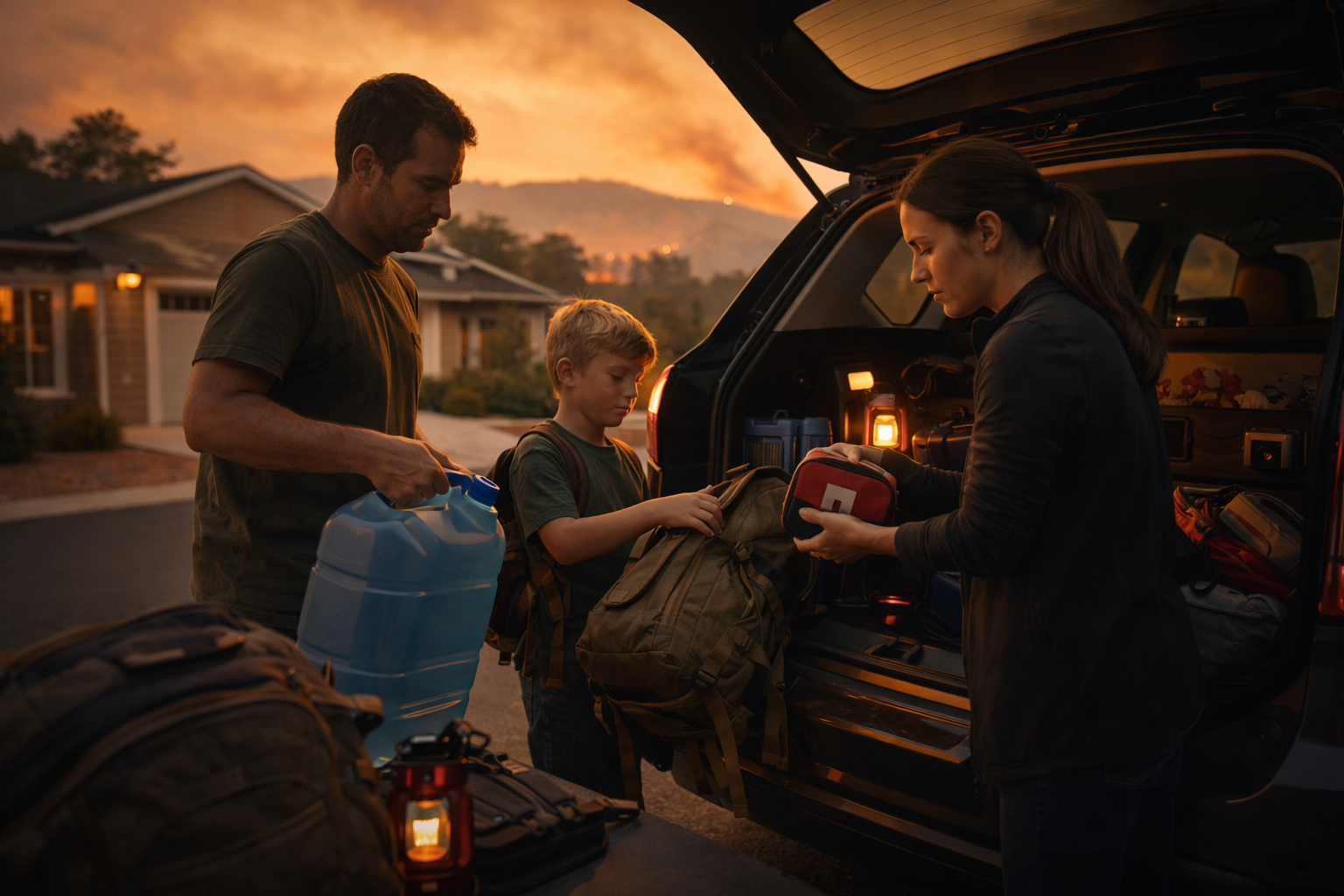
On November 8, 2018, the Camp Fire tore through Paradise, California. Residents had as little as 15 minutes to evacuate. The fire moved at 80 football fields per minute, destroying nearly 19,000 structures and killing 85 people. It remains the deadliest and most destructive wildfire in California history.
Paradise wasn't unprepared. It had evacuation plans. But the speed of the fire overwhelmed every assumption. Roads gridlocked. Cell towers burned. Families were separated with no way to reach each other.
The lesson was brutal and clear: when wildfire comes, you don't rise to the occasion. You fall to the level of your preparation. This checklist is designed to raise that floor.
The 5-Minute Grab List
If you hear a knock on the door and a firefighter says "go, now" — you have time for one sweep through the house. That's it. Everything on this list should already be in a known location, ideally near your front door or in your car.
- People and pets — confirm everyone is accounted for
- Medications that can't be missed (insulin, inhalers, heart medication)
- Phone, charger, and portable battery pack
- Wallet, keys, ID, and insurance cards
- Go-bag (if pre-packed and ready — see below)
- Shoes with closed toes — embers and debris will be on the ground
- One change of clothes per person if within arm's reach
What to leave behind: Everything else. Furniture, electronics, photo albums you haven't digitized. None of it is worth your life. The average house fire reaches flashover in 3-4 minutes. Wildfire moves even faster across dry brush.
NomadCore tip: Store photos of your valuables, insurance declarations pages, and key documents in NomadCore's encrypted document storage. If you lose everything physical, your digital copies are safe — accessible from any device, even offline. Take 20 minutes this weekend to photograph each room and upload the images.
The 30-Minute Evacuation
If you have a warning — maybe a Wireless Emergency Alert, a neighbor's call, or visible smoke on the horizon — 30 minutes lets you be deliberate. Do everything on the 5-minute list first, then:
- Load go-bags for every family member into the car
- Grab important documents: passports, birth certificates, property deeds
- Take irreplaceable items: family photos, hard drives with backups, heirlooms that fit in a box
- Fill water bottles and grab non-perishable snacks
- Grab pet carriers, leashes, pet food, and veterinary records
- Load a cooler with any temperature-sensitive medications
- Charge devices in the car while you load
For families with children
- Grab comfort items for young kids (a specific toy, blanket)
- Pack diapers, formula, or any infant supplies
- Bring entertainment for the car (tablet, books) — evacuations involve hours of waiting
- Tell kids the plan calmly: "We're going to [place]. We're going to be safe."
The 30-minute window closes fast. Don't spend 20 of those minutes deciding what to take. Decide now, while you're reading this, and write it down.
Preparing Your Home Before You Leave
If time allows — and only if everyone is already loaded in the car — these actions can help your home survive:
- Close all windows and doors (don't lock them — firefighters may need entry)
- Move flammable furniture away from windows
- Shut off propane or natural gas at the tank/meter
- Leave exterior lights on so firefighters can see your house in smoke
- Move propane grills and patio furniture away from the structure
- Place a ladder against the house for firefighter roof access
- Connect garden hoses and leave them out (if water pressure holds)
- Close garage doors but leave them unlocked
Do not: Get on the roof with a hose. Do not stay behind to "protect" the house. Firefighters train for years to do that job. According to Cal Fire, the leading cause of civilian wildfire deaths is late evacuation — people who waited too long trying to defend property.
Go-Bag Essentials for Wildfire Season
A standard emergency go-bag covers the basics: water, food, first aid, flashlight. During wildfire season, add these items specific to smoke, heat, and ash:
- N95 or P100 respirator masks — one per person, properly fitted. Wildfire smoke contains particulate matter 2.5 (PM2.5) that penetrates deep into the lungs. Cloth masks do not filter it.
- Sealed swim goggles or safety goggles — smoke and ash cause severe eye irritation. Standard glasses aren't enough.
- Long-sleeve cotton shirts and long pants — ember protection. Synthetic fabrics melt.
- Heavy-duty work gloves — for handling hot or debris-covered objects
- Extra water beyond the standard 1 gallon/person/day — heat and smoke increase dehydration
- Battery-powered or hand-crank NOAA weather radio — cell towers burn. Radio doesn't.
- Headlamp with red-light mode — smoke can reduce visibility to near zero, even in daylight
- Wet bandanas in a zip-lock bag — backup smoke protection and cooling
- Printed map of your area — GPS relies on satellites, but your phone may die
Pack everything in a bag that's ready to go by the front door or in the trunk of your car from June through November (or year-round, depending on your region). The National Fire Protection Association reports that wildfire seasons have grown 105 days longer since the 1970s — what used to be a summer concern now stretches from spring through fall.
Evacuation Routes
One evacuation route is not enough. The 2018 Camp Fire proved this when the main road out of Paradise — Skyway — became a parking lot. Residents on the gridlocked road abandoned cars and ran on foot.
Plan at least three routes out of your area:
- Primary route — the fastest way to your designated evacuation point or shelter
- Secondary route — a different direction entirely, in case fire blocks your primary
- Backroad / rural route — slower but less likely to gridlock
Common route-planning mistakes
- Assuming GPS will work. Cell towers and data connections fail in wildfire zones. By the time you need directions most, your phone may have no signal.
- Only knowing highway routes. Everyone else will be on the highway. Know the back roads.
- Not accounting for road closures. Fire crosses roads. Bridges get shut down. Power lines fall. Your route must adapt.
- Heading toward the fire. It sounds obvious, but in heavy smoke, disorientation is real. Know which direction the fire is coming from before you drive.
- Waiting for official evacuation orders. If you can see flames or the sky is orange, go. An evacuation warning means "be ready." If you have kids, elderly family members, or pets — treat warnings as orders.
NomadCore tip: Download offline maps of your area and all three evacuation routes in NomadCore before wildfire season starts. When cell towers go down and Google Maps shows a blank screen, your offline maps still work. Mark your routes, rally points, and shelter locations directly on the map.
Drive the routes
Planning on paper is good. Driving the routes is better. On a calm weekend, drive each route with your family. Note landmarks, gas stations, and potential bottlenecks. Pay attention to narrow roads, one-lane bridges, and areas with heavy tree cover that could block the road if they fall.
After the Evacuation
Getting out is step one. What happens next matters just as much.
At the shelter or hotel
- Check in with your out-of-state contact so family knows you're safe
- Register with the Red Cross Safe and Well registry (safeandwell.communityos.org)
- Keep your phone charged — information about your area will come via alerts
- If at a public shelter, ask about pet-friendly areas (not all shelters allow animals)
- Keep medications organized and accessible
NomadCore tip: Use family sharing to let your group know where you are in real time. Each family member can update their status and location, so nobody is wondering "did they make it out?" Coordinating who goes to which shelter is easier when everyone can see the plan on one screen.
Documenting damage for insurance
If your home is damaged or destroyed, the insurance claim process starts immediately. The families who recover fastest are the ones who documented before the fire:
- Before the fire: Walk through every room and record a video. Open drawers, closets, cabinets. Narrate what you see and estimate values. Store this video in cloud backup and in NomadCore's document storage.
- After the fire: Do not enter your property until officials confirm it's safe. When cleared, photograph everything. Don't clean up or dispose of anything before documenting it.
- File your claim early. After major wildfires, insurance adjusters are overwhelmed. The sooner you file, the sooner you're in the queue. Contact your insurer within 24 hours if possible.
- Keep every receipt — hotel stays, meals, clothing, medication refills. Most homeowner policies include Additional Living Expenses (ALE) coverage that reimburses these costs.
Air quality after a wildfire
The danger doesn't end when the flames are out. Wildfire smoke can degrade air quality for weeks across hundreds of miles. The EPA's AirNow.gov provides real-time air quality data. Keep N95 masks available, limit outdoor time when AQI exceeds 150, and run HVAC systems on recirculate with clean filters.
The 60-Second Version
If you take away only five things from this article:
- Pre-pack a go-bag with wildfire-specific gear — N95 masks, goggles, cotton clothing. Keep it by the door from June through November.
- Know three routes out. Drive them all at least once. Download them for offline access.
- Digitize everything that matters. Insurance papers, photos of every room, medical records. If the house burns, your documents survive.
- Don't wait for an official order. If you see smoke or flames, leave. Treat evacuation warnings as orders when you have kids or pets.
- Coordinate with your family now. Who grabs the kids? Who grabs the pets? Where do you meet if separated? Decide today.
Wildfires are getting faster, larger, and less predictable. The 2021 Marshall Fire in Colorado gave some residents less than 30 minutes — and it happened in December, outside traditional fire season. The 2023 Maui fire in Lahaina killed 101 people in a town many assumed was safe from wildfire.
You don't get to choose when a fire starts. You only get to choose how ready you are when it does.
NomadCore tip: Build your complete wildfire evacuation plan in NomadCore's emergency plan feature. Add your grab lists, evacuation routes, rally points, insurance documents, and family roles — all in one place. Share it with every family member via QR code. Review it together at the start of every fire season. The 30 minutes you spend setting it up could save hours of chaos when the smoke arrives.
Download NomadCore to build your wildfire evacuation plan with offline maps, encrypted document storage, family sharing, and emergency checklists — all accessible when cell towers and internet go down.